
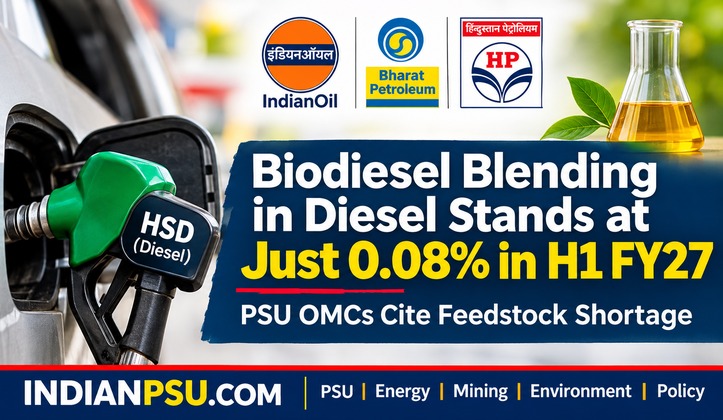
Biodiesel Blending in Diesel Stands at Just 0.08% in H1 FY27; PSU OMCs Remind Feedstock Shortage
National Biofuels Policy envisages indicative 5% blending by 2030, but more than 4,700 crore litres of diesel sold during April–September 2026 contained no biodiesel
Read in your preferred Language :
India’s biodiesel blending programme continues to remain far below its indicative target, with Public Sector Oil Marketing Companies (OMCs) reporting an overall blending level of just 0.08% during April–September 2026, citing limited availability of feedstock.
Indian Oil Corporation Limited (IOCL), Bharat Petroleum Corporation Limited (BPCL) and Hindustan Petroleum Corporation Limited (HPCL) have clarified that the National Policy on Biofuels, 2018, amended in 2022, envisages an indicative target of 5% biodiesel blending by 2030. However, actual blending remains significantly below the target because of constraints in the availability of raw materials required for biodiesel production.
During FY 2025-26, the PSU OMCs achieved an overall biodiesel blending level of only 0.18%.
The figures for the first six months of the current financial year underline the limited penetration of biodiesel in India’s diesel supply chain.
More than 4,700 crore litres of diesel sold without biodiesel
During April–September 2026, PSU OMCs recorded total High-Speed Diesel (HSD) sales of approximately 4,900 crore litres.
Of this, more than 4,700 crore litres of diesel was sold without any biodiesel blending. Biodiesel was blended only in the remaining approximately 200 crore litres of diesel.
The companies stated that the total biodiesel blended during this period was approximately 4 crore litres, translating into an average blending level of 2% in the diesel that contained biodiesel.
Consequently, the overall biodiesel blending level across total HSD sales stood at just 0.08% during the six-month period.
OMCs assert compliance with diesel quality standards
The PSU OMCs have also emphasised that all HSD sold in the country, including the limited quantity containing biodiesel, conforms to the prescribed quality standards.
According to the companies, diesel sales are governed by BIS standard IS 1460, which specifies requirements for automotive diesel fuel and forms part of the publicly notified National Policy on Biofuels.
The companies reiterated their commitment to supplying fuel in accordance with prescribed quality standards and applicable regulations.
Biodiesel blending programmes in other countries
The OMCs also pointed to international practices, citing countries such as Indonesia, Malaysia and Brazil, where biodiesel blending programmes are implemented based on domestic feedstock availability.
Blending levels in these countries range from 10% to 50%, depending on the availability of feedstock and the respective country’s biofuel programme.
The gap between policy target and actual blending
India’s indicative target of 5% biodiesel blending by 2030 remains significantly higher than the actual blending level reported by PSU OMCs.
The latest figures highlight the challenges facing the biodiesel programme, particularly the availability of feedstock and the ability to scale up biodiesel production and procurement.
With overall blending remaining at 0.08% during the first half of FY 2026-27, the gap between the national policy ambition and actual implementation remains substantial.
The PSU OMCs have maintained that fuel supplied to consumers meets prescribed quality standards and applicable regulatory requirements.