
IndianOil Pipeline Unions Move President, Seek Immediate Withdrawal of Synergy System
Nine recognised unions warn that proposed restructuring of IndianOil's Pipelines Division could compromise operational safety, technical expertise and India's energy security
Read in your preferred Language :
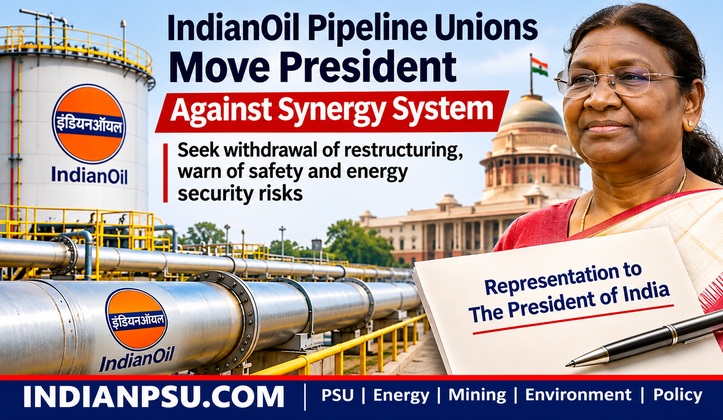
Nine recognised unions of Indian Oil Corporation Limited (IndianOil) have jointly approached President Droupadi Murmu, seeking her urgent intervention to stop the proposed Synergy System and restructuring of the corporation’s Pipelines Division.
In a joint representation dated November 27, 2026, the unions have warned that merging pipeline locations with Marketing locations and shifting specialised operational responsibilities could weaken pipeline maintenance, technical supervision and emergency response mechanisms.
The unions have described the proposed changes as a matter extending beyond employee grievances, arguing that the safety of critical national energy infrastructure and millions of citizens could be at stake.
29,000 km Pipeline Network Under Focus
Highlighting the strategic importance of IndianOil’s pipeline infrastructure, the unions have pointed out that the corporation operates approximately 22,000 km of petroleum product pipelines and 7,000 km of gas pipelines.
The network passes through nearly 18,000 villages, agricultural lands, industrial areas and densely populated regions across the country.
According to the unions, the Pipelines Division has developed nearly six decades of specialised technical expertise and operational experience in maintaining this critical infrastructure.
They have cautioned that pipeline operations cannot be managed like routine marketing activities, as they require continuous monitoring, specialised maintenance, regular patrolling, inspection and immediate emergency response.
Unions Flag Safety Risks in Proposed Restructuring
The representation raises serious concerns over the proposed merger of pipeline locations with Marketing locations under the Synergy System.
The unions argue that such consolidation could dilute specialised technical responsibilities and weaken operational accountability.
They have also expressed apprehension that manpower rationalisation and restructuring could reduce the availability of experienced technical personnel at pipeline locations.
Warning of potentially serious consequences, the unions have stated that pipeline leakage, fire or explosions resulting from inadequate maintenance or delayed intervention could lead to loss of human lives, destruction of public and private property, environmental pollution and disruption of essential energy supplies.
The unions have cautioned that an administrative decision, if implemented without adequately assessing its operational implications, could eventually develop into a major national safety concern.
Six Decades of Technical Expertise at Risk
Another major concern highlighted in the representation is the possible erosion of institutional knowledge accumulated by the Pipelines Division over nearly six decades.
The unions maintain that experienced pipeline personnel possess specialised knowledge of geographical challenges, maintenance requirements, emergency situations and safety procedures.
They fear that transferring operational responsibilities towards the Marketing Division could fragment this expertise and weaken technical supervision.
According to the unions, administrative consolidation and cost optimisation cannot become substitutes for specialised technical leadership and operational accountability.
Demand Full-Time Director (Pipelines)
The recognised unions have also raised the issue of the continued vacancy of the Director (Pipelines) position.
They argue that the absence of a dedicated Director at a time when the division is facing significant organisational restructuring raises questions about leadership, accountability and strategic decision-making.
The unions have demanded the immediate appointment of a full-time Director (Pipelines).
Eight Demands Placed Before President
Seeking presidential intervention, the nine recognised unions have put forward eight specific demands:
- Immediate withdrawal of the proposed Synergy System in the Pipelines Division.
- Withdrawal and reconsideration of the proposed restructuring, including the merger of pipeline locations with Marketing locations.
- Protection of pipeline safety, operational efficiency, preventive maintenance and emergency response mechanisms.
- Adequate deployment of experienced and technically qualified manpower at every pipeline location.
- Preservation of the specialised technical expertise and institutional knowledge of the Pipelines Division.
- Immediate appointment of a full-time Director (Pipelines).
- Protection of public safety, public property, environmental interests and national energy security.
- Meaningful consultation with all recognised pipeline unions before taking any final decision on the proposed changes.
The representation has also been forwarded to the Prime Minister, Union Petroleum Minister, Vice-President, Speaker of the Lok Sabha, Cabinet Ministers, Members of Parliament and Chief Ministers of all states.
A Larger Question for IndianOil Management
The unions have made it clear that their opposition is not merely an employment-related grievance or resistance to organisational change. Their central argument is that the specialised nature of pipeline operations demands dedicated technical management, experienced manpower and clearly defined accountability.
The representation places the responsibility on IndianOil management and the Ministry of Petroleum and Natural Gas to address these concerns before implementing changes that could have implications for the safety and reliability of the country’s energy transportation infrastructure.
Editorial note: The article is based on the joint representation dated November 27, 2026. The safety concerns and allegations are attributed to the recognised unions; they are not presented as independently established findings.