
Kerala Seeks Centre’s Intervention to Verify Ethanol Content in Petrol, Raises Questions Over E20 Fuel Testing
The controversy has brought the Centre's ethanol blending programme under renewed public scrutiny
Read in your preferred Language :
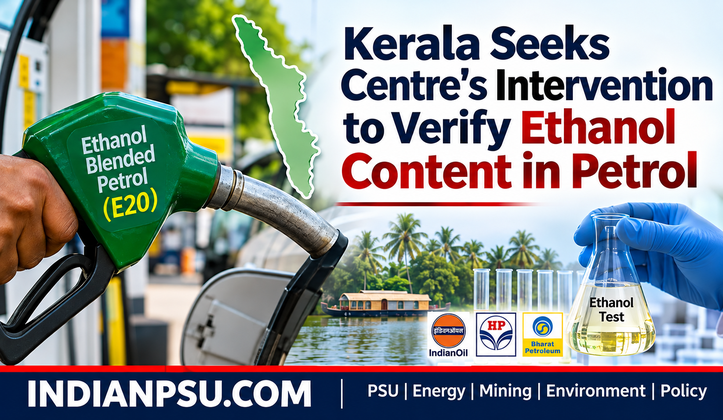
Kerala Food and Civil Supplies Minister Anoop Jacob has written to Union Petroleum Minister Hardeep Singh Puri, seeking intervention to obtain 100% pure petrol samples from oil marketing companies. The move follows concerns over ethanol blending levels and the possible impact of E20 fuel on vehicle engines.
Kerala has sought the Central Government’s intervention to ensure that oil marketing companies provide 100% ethanol-free petrol samples to enable scientific verification of ethanol blending levels in petrol sold across the state.
Food and Civil Supplies Minister Anoop Jacob has written to Union Petroleum and Natural Gas Minister Hardeep Singh Puri and Minister of State Suresh Gopi, requesting their intervention to direct oil marketing companies to provide the required reference samples without further delay.
The Kerala government’s move comes amid growing concerns over the ethanol content in petrol following allegations in neighbouring Karnataka that fuel samples contained ethanol levels exceeding the prescribed 20% limit.
Oil Companies Allegedly Backtrack on Providing Samples
The Kerala Civil Supplies Department has been collecting petrol samples from retail outlets across the state over the past two weeks. These samples have been handed over to government-run Chemical Examiners’ Laboratories for testing.
However, laboratory officials have informed the department that 100% pure petrol samples are necessary for comparative testing, instrument calibration and preparation of calibration standards to accurately determine ethanol concentration.
According to Anoop Jacob, companies including Indian Oil Corporation (IOCL) and Bharat Petroleum Corporation Limited (BPCL) had initially agreed to provide the reference samples but subsequently declined to hand them over.
Repeated efforts by senior state government officials to obtain the samples reportedly failed, prompting the minister to approach the Union Government.
Karnataka Controversy Triggers Fresh Concerns
The controversy over ethanol blending intensified after Karnataka reported allegedly excessive ethanol content in petrol samples collected from retail outlets.
Karnataka had claimed that certain samples contained ethanol levels of up to 31.2%, significantly higher than the prescribed 20% limit.
Public sector oil marketing companies, however, rejected the allegations and questioned the sampling and testing methodology adopted by the Karnataka government. They maintained that the E20 petrol supplied by them complies with the applicable Bureau of Indian Standards specifications.
Against this backdrop, Kerala initiated its own inspection and testing exercise to establish whether petrol sold in the state complies with prescribed ethanol blending limits.
Kerala Says Testing Is Not Intended to Target Oil Companies
Anoop Jacob has clarified that the exercise is not intended to undermine the credibility of oil marketing companies.
Instead, the state government wants to address public concerns regarding the possible impact of ethanol-blended petrol on automobile engines, particularly if the ethanol content exceeds permissible limits.
The minister has emphasised that testing must follow scientifically accepted procedures so that the findings remain credible and legally sustainable.
He has also indicated that the government would consider legal action if laboratory results establish that ethanol content in petrol exceeds the prescribed limit.
E20 Fuel Debate Gains Momentum
The controversy has brought the Centre’s ethanol blending programme under renewed public scrutiny.
India has been promoting ethanol blending as part of its strategy to reduce dependence on imported crude oil, cut carbon emissions and support the domestic sugar and ethanol industries.
However, concerns regarding vehicle compatibility, fuel efficiency, engine performance and adherence to prescribed blending standards have become increasingly prominent.
Kerala’s demand for independent verification adds another dimension to the ongoing debate over E20 petrol.