
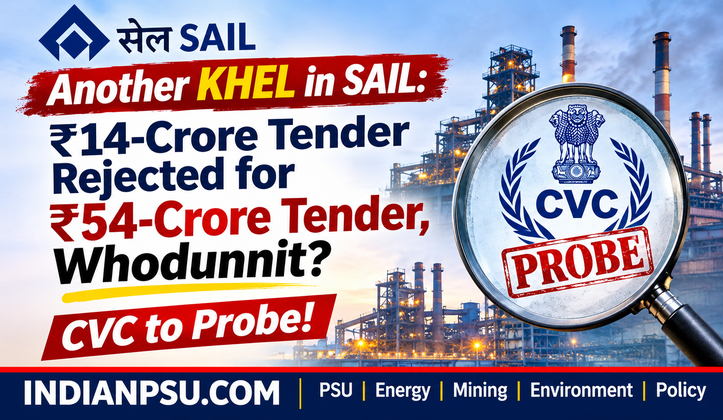
Another KHEL in SAIL: ₹14 Crore Tender Rejected, ₹54 Crore Deal Awarded – Whodunnit? CVC to Probe!
A nearly ₹40-crore price gap, rejection of a reportedly lower bid and questions over the procurement process put SAIL's HR digitisation contract under the vigilance scanner
Read in your preferred Language :
Steel Authority of India Limited (SAIL) is facing fresh questions over a ₹54-crore HR digitisation contract, with allegations surrounding the tendering process reportedly prompting scrutiny by the Central Vigilance Commission (CVC).
At the centre of the controversy is a startling price difference: a reportedly ₹14-crore bid was rejected, while the contract was subsequently awarded for approximately ₹54 crore.
The difference—nearly ₹40 crore—raises uncomfortable questions about the procurement process, the rejection of the competing bid and the decision to accept a substantially higher quotation.
The question is simple: Who took the decisions that led to this massive price difference?
₹14 crore versus ₹54 crore
According to allegations surrounding the tender, Deloitte reportedly quoted approximately ₹14 crore, inclusive of GST, but its bid was rejected because it allegedly reached SAIL headquarters three hours after the prescribed deadline.
The tender process subsequently proceeded, with Boston Consulting Group India Private Limited (BCG) reportedly emerging as the successful bidder at approximately ₹54 crore.
If the reported figures are correct, the final contract value was nearly four times the lower quotation.
While procurement deadlines must be followed and tender conditions cannot be selectively relaxed, the circumstances surrounding the rejection of the lower bid and its impact on competition and price discovery merit examination.
Was the rejection strictly in accordance with the tender conditions? Did it materially alter the competitive landscape? And was the eventual contract price independently assessed to establish its reasonableness?
These questions are now central to the controversy.
Questions over the procurement route
The complaint reportedly also questioned why the procurement was not initiated through the Government e-Marketplace (GeM), despite a budgetary provision for the project.
The procurement route adopted by SAIL, the approvals obtained and the justification for not using GeM reportedly form part of the issues raised.
The tender reportedly followed a Quality-cum-Cost Based Selection (QCBS) mechanism, with 80% weightage assigned to technical evaluation and 20% to financial evaluation.
The participation of major consulting firms makes the eventual price difference particularly significant. SAIL must explain how the ₹54-crore quotation was evaluated and why it was considered financially reasonable.
Who approved the ₹54-crore deal?
The project reportedly received approval from the SAIL Board in September 2024 for engaging an external consultant for HR policy frameworks and related systems across the company’s plants and units.
A tender committee was subsequently constituted to oversee the selection process, while the final award reportedly rested with the Director (Personnel).
The vigilance investigation must establish whether the cost estimate was realistic, whether the tender conditions ensured genuine competition, whether the rejection of the lower bid was justified and whether the final contract value was adequately benchmarked.
Modernisation cannot become a blank cheque
Digitisation of HR operations across a large steel company is undoubtedly a complex exercise. But complexity cannot justify an unexplained escalation in procurement costs.
A ₹54-crore contract demands clearly defined deliverables, measurable milestones, transparent pricing and accountability for implementation.
The central question is no longer whether SAIL needs HR digitisation. It is whether the company paid a reasonable price and whether the procurement process protected its financial interests.
₹14 crore versus ₹54 crore. A rejected bid. A contract awarded. A vigilance probe.
The CVC investigation must establish whether any irregularity occurred—and, if so, who was responsible.
The ₹40-crore question remains: Whodunnit?
We Report – You Decide…