

Coal Gasification: Can It Solve India’s Electricity Woes?
New technology offers a way to unlock greater value from domestic coal, but cost, efficiency and environmental concerns will determine its role in India’s power future
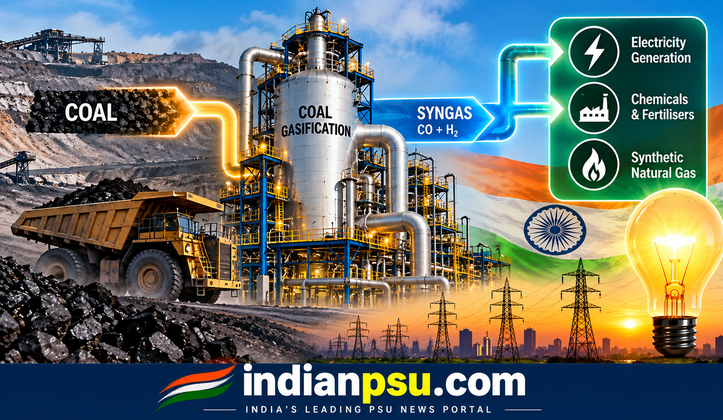
India’s growing electricity demand has brought energy security back into sharp focus. With coal continuing to play a major role in power generation, the country is exploring ways to extract greater value from its vast domestic reserves. Coal gasification has emerged as one such option, with the potential to support electricity generation, reduce dependence on imported fuels and create new industrial opportunities.
But can coal gasification actually solve India’s electricity woes? The technology offers significant possibilities, although its contribution will depend on commercial viability, operational performance and the scale of deployment.
How coal gasification works
Unlike conventional coal-fired power plants, which burn coal to produce steam and generate electricity, coal gasification converts coal into synthesis gas, commonly known as syngas. The gas primarily contains carbon monoxide and hydrogen and can be processed for use in power generation, chemicals, hydrogen and synthetic natural gas.
This creates opportunities to use domestic coal beyond conventional electricity production. It could also support the manufacture of industrial products that India currently imports, strengthening domestic supply chains and reducing exposure to international commodity markets.
A strategic opportunity for India
The government’s push to expand coal gasification reflects its broader objective of reducing import dependence and promoting value addition within the country. The Union Cabinet approved a ₹37,500-crore scheme in May 2026 to promote surface coal and lignite gasification, alongside the target of gasifying 100 million tonnes annually by 2030.
For Coal India Limited and other public sector enterprises, this policy direction could open opportunities in gasification projects, engineering, equipment manufacturing and downstream industrial development.
Coal India could explore partnerships to convert suitable coal resources into higher-value products, while engineering companies and energy-sector PSUs could participate in plant construction, processing infrastructure and associated projects.
However, the government’s gasification target is not the same as a target for electricity generation. Much of the technology’s potential lies in producing chemicals and other industrial feedstocks. Its contribution to the power sector will depend on how many projects are designed for electricity production and whether they can compete economically with established alternatives.
The cost and efficiency challenge
The biggest question is whether gasification-based electricity can be produced at a competitive cost.
Gasification plants require substantial capital investment in gasifiers, gas-cleaning systems and associated equipment. Converting coal into syngas and then into electricity also involves energy losses. The economics will depend on coal quality, plant efficiency, financing costs, operating performance and the availability of suitable technology.
Environmental considerations are equally important. Gasification is not automatically a clean or low-carbon solution. Emissions, water consumption, pollution controls and carbon capture must be assessed before its environmental benefits can be established.
Can it end India’s power problems?
Coal gasification could diversify India’s energy options, improve the utilisation of domestic resources and create new industrial value chains. If commercially successful, gasification-based power plants could contribute to electricity supply alongside conventional coal-fired stations, renewables, storage and other generating technologies.
However, it cannot independently resolve challenges involving coal transportation, transmission infrastructure, peak demand, power affordability and the integration of renewable energy.
The priority should therefore be to demonstrate the technology’s performance through commercially credible projects, with transparent assessments of electricity costs, efficiency and environmental impact.
Coal gasification is a strategic opportunity for India, but not a standalone solution to its electricity woes. Its ultimate success will depend on whether the technology can convert the country’s coal advantage into reliable, affordable and environmentally responsible energy.