
Coal India Fails Its Core Mandate: Coal at Mines, Crisis at Power Plants
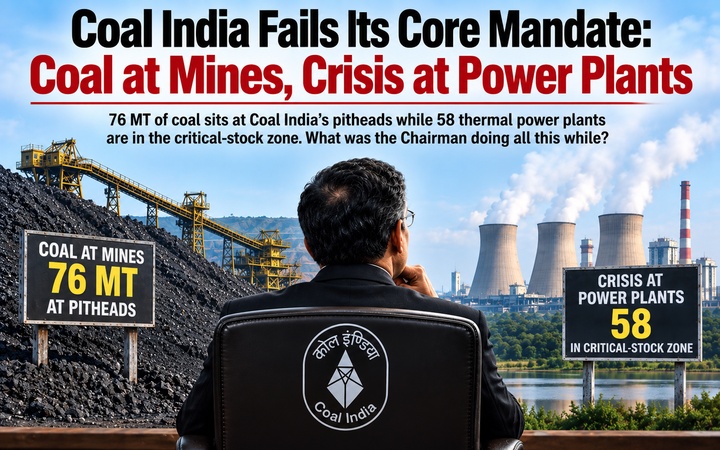
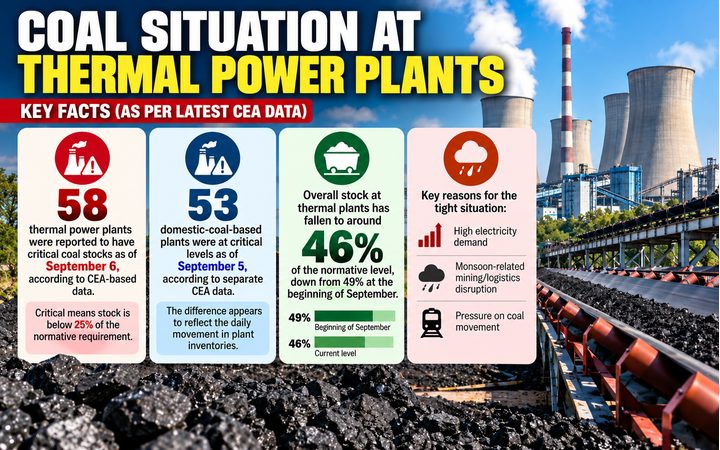
76 MT of coal at CIL pitheads, yet 58 power plants face critical stocks - India has coal, but Coal India is failing to get it where it is needed
Coal India Limited cannot simply celebrate production and dispatch growth while power plants are struggling for coal.
The uncomfortable question is now staring the company’s top management in the face:
What was Coal India’s Chairman doing all this while?
The monsoon does not arrive unexpectedly. Every year, heavy rains disrupt mining, loading and coal evacuation. Coal India knows this. Its management knows this. The government knows this.
Yet, as the monsoon season progressed, coal stocks at dozens of power plants deteriorated sharply – even as around 76 million tonnes remained piled up at CIL pitheads.
That is the central contradiction.
Coal is available. The delivery system is failing.
Coal India can point to higher production and dispatches. But for the power sector, the only number that ultimately matters is the coal lying at the power plant.
A thermal generator cannot burn coal sitting at a mine hundreds of kilometres away.
So the real test of CIL’s performance is not how much coal it digs out.
It is whether the coal reaches the power plant before its stock becomes critical.
And by that measure, serious questions arise.
Where was the pre-monsoon planning?
If CIL knew evacuation would slow during the rains, why were vulnerable power plants not adequately stocked beforehand?
Why weren’t railway rakes planned and secured more aggressively?
Why did evacuation bottlenecks persist?
Why did CIL allow massive quantities of coal to accumulate at pitheads while power stations moved towards critical inventory levels?
And why did emergency measures, including additional road transportation, become necessary only after the situation had deteriorated?
These are not questions about rainfall.
They are questions about management.
Coal India’s own long-term plans recognise the need for massive investment in evacuation infrastructure and First Mile Connectivity. That investment is necessary – but India’s power sector needs reliable coal today, not merely better infrastructure several years from now.
Don’t hide behind Railways
Indian Railways undoubtedly has a major role in coal transportation. Power generators and the Ministry of Power also carry responsibilities.
But CIL cannot wash its hands of the problem by pointing elsewhere.
Coal India is the country’s dominant domestic coal supplier. Its responsibility does not end when coal is extracted.
Coal sitting at the pithead is inventory. Coal reaching a power station is supply.
There is a world of difference between the two.
The Chairman’s real test
A Coal India Chairman should certainly be judged on production, dispatches, profits, dividends and new mines.
But India’s energy security demands another question:
Did Coal India deliver the coal before the power plant became critically short?
If not, the management owes the country an explanation.
The monsoon was predictable.
The risk was known.
The coal was available.
So what went wrong?
India does not need to wait for power plants to run out of coal before asking that question.
And this time, it will be difficult for Coal India Limited Chairman B Sairam to pass the buck to the CMD of a subsidiary.
Sairam himself holds the additional charge of CMD, Northern Coalfields Limited (NCL) – Coal India’s highest coal-producing subsidiary.
That makes the question even more pointed: if coal evacuation and supply to power plants have become a problem, who exactly is the Chairman going to blame?
The buck stops at the top.
Coal India may have plenty of coal. But if that coal cannot reach India’s power plants when they need it, CIL is failing its core mandate.
Repeated emails and reminders to Chairman. Coal India Limited, B. Sairam, failed to elicit any response.
Editor’s Take:
True leadership is defined not by authority, but by accountability. A true leader leads from the front, sets the standard through actions, and inspires others by example. They celebrate the achievements of their team by sharing the credit, while taking ownership and responsibility when challenges arise. Leadership is about building trust, demonstrating integrity, and standing firmly with the team in both success and adversity.
The bigger question being whispered in industry circles is whether Sairam enjoys such strong confidence within the Ministry that the uncomfortable questions simply will not be asked – and whether the axe could instead fall on the neck of a CMD of a CIL subsidiary who does not command the same clout in political circles.
If that perception gains ground, it raises a deeply uncomfortable question for Coal India: is accountability determined by performance – or by proximity to power?