

ONGC Challenges Unsolicited CRISIL ESG Rating, Disputes Scores and Board Attendance Claims
“मान न मान, मैं तेरा मेहमान” - “बेगानी शादी में अब्दुल्ला दीवाना? या फिर बिन बुलाए बाराती
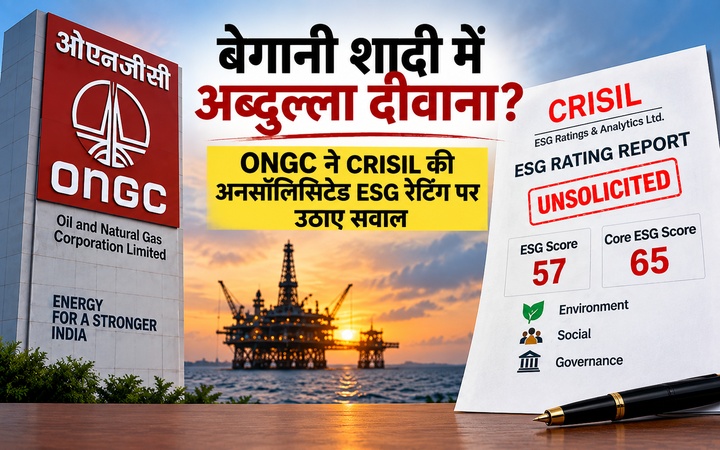
Oil and Natural Gas Corporation Limited (ONGC) has formally disputed an unsolicited ESG Rating Report issued by CRISIL ESG Ratings & Analytics Ltd, saying the assessment was prepared without its engagement or consultation and does not accurately reflect the company’s sustainability initiatives, governance framework or disclosures.
In a filing to the stock exchanges, ONGC said it had neither appointed CRISIL ESG Ratings nor participated in the preparation or finalisation of the report. The company said it therefore disagrees with the ESG scores of 57 and 65 assigned under the CRISIL ESG and CRISIL Core ESG assessments respectively.
ONGC said its environmental and sustainability initiatives are comprehensively disclosed in its Business Responsibility and Sustainability Report (BRSR). The company specifically pointed to its decarbonisation programme and reiterated its target of achieving net-zero Scope 1 and Scope 2 operational emissions by 2038.
ONGC Disputes Governance Assessment
ONGC has also challenged specific observations in the CRISIL report concerning the attendance of its independent directors at Board and Board-level committee meetings.
According to ONGC, the report contains factual inaccuracies on the issue. The company stated that its independent directors had 100% attendance at Board and Board-level Committee meetings, except for one instance of leave of absence at a committee meeting.
ONGC said that after accounting for the approved leave, the effective attendance rate works out to approximately 92.30%.
The company’s clarification comes against the backdrop of growing reliance on ESG assessments by investors and other stakeholders. ONGC’s position is that an assessment prepared without consultation with the company should not be treated as an accurate reflection of its sustainability and governance performance.
The filing does not represent any change in ONGC’s financial performance or business operations. It is essentially a formal disclosure to investors setting out the company’s disagreement with the external ESG assessment and correcting what it describes as factual inaccuracies in the report.