
Stress Management and Burnout: A Critical Soft-Skills Programme for PSU Managers
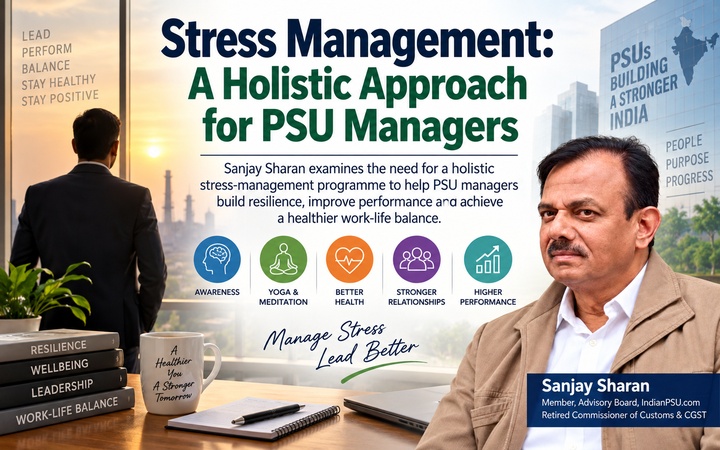
Sanjay Sharan examines the need for a holistic stress-management programme to help PSU managers build resilience, improve performance and achieve a healthier work-life balance
By Sanjay Sharan
Stress, often manifesting as burnout when it becomes prolonged and unmanaged—is an increasingly important concern across the corporate and Public Sector Undertaking (PSU) universe. Managers at every level, from Chairman, Managing Director and CEO to senior and middle management, operate in environments characterised by demanding targets, constant decision-making, organisational pressures, tight timelines and competing priorities.
Yet, stress is often experienced without sufficient awareness of its causes, symptoms and consequences.
Unmanaged stress can adversely affect performance, physical and mental well-being, interpersonal relationships, work-life balance, time management, decision-making and overall positivity. There is therefore a compelling need for managers to understand stress and develop practical strategies to manage it effectively.
Understanding Stress
Stress may be understood as the mental and physiological response to pressures or demands that an individual perceives as exceeding, or threatening to exceed, their available capacity to cope.
Stress, however, is not necessarily harmful in itself. Its impact depends significantly on its intensity, duration and how an individual responds to it.
A useful analogy is provided by Butler and Hope (1995), who compare stress to the pressure in a car tyre. When the pressure is appropriate, the vehicle moves smoothly. When it is too low, the ride becomes sluggish and uncomfortable; when it is too high, control can become difficult. Similarly, an appropriate level of pressure can facilitate performance, while excessive or prolonged pressure can undermine effectiveness and well-being.
Eustress and Distress
Not all stress is negative.
Eustress refers to positive or motivating stress that can stimulate performance, concentration and achievement. A sportsperson preparing for competition, for example, may experience pressure that motivates disciplined practice and performance.
Distress, on the other hand, occurs when pressure becomes excessive, prolonged or difficult to manage. It may arise from an imbalance between the demands placed upon an individual and the mental, emotional, physical and organisational resources available to deal with those demands.
When distress remains unmanaged, it can contribute to exhaustion, disengagement, reduced productivity, impaired relationships and, in some cases, burnout.
Why Stress Management Matters for PSU Managers
PSU managers operate in complex organisational ecosystems involving government expectations, public accountability, financial and operational targets, regulatory requirements, stakeholder management and employee relations.
Effective stress management is therefore not merely a wellness initiative. It is an important leadership and managerial capability.
A manager who understands stress is better positioned to:
- Maintain clarity and composure during high-pressure situations
- Improve decision-making and prioritisation
- Manage time and competing demands more effectively
- Build healthier workplace relationships
- Recognise early warning signs of burnout
- Improve work-life integration
- Sustain motivation and positivity
- Develop greater emotional resilience
- Support the well-being and performance of teams
A Holistic Approach to Stress Management
Stress management should not be reduced to a single technique or a short-term intervention. It is a comprehensive process involving greater awareness of one’s work, thoughts, emotions, lifestyle, relationships and overall sense of purpose.
A holistic stress-management programme for PSU managers can therefore cover:
- Understanding Stress and Burnout
Identifying sources, symptoms, triggers and warning signs. - Workplace Stressors
Managing deadlines, targets, organisational pressures, leadership responsibilities and workplace conflicts. - External Stressors
Understanding how family, social, financial and environmental pressures can affect professional performance. - Internal Stressors
Examining thought patterns, expectations, perfectionism, fear, self-imposed pressure and emotional responses. - Time and Priority Management
Distinguishing between urgency and importance and developing sustainable approaches to workload management. - Emotional Resilience and Positive Thinking
Building the capacity to respond constructively to pressure rather than merely reacting to it. - Work-Life Balance
Developing healthier boundaries and sustainable routines. - Food, Lifestyle and Physical Well-being
Understanding the relationship between nutrition, sleep, physical activity and stress. - Yoga, Meditation and Mindfulness
Introducing practical techniques that can support relaxation, self-awareness, concentration and emotional regulation. - Purpose and Meaning
Encouraging managers to reflect on personal values, professional purpose and the broader meaning attached to their work.
From Stress Awareness to Stress Management
The objective of stress-management training is not to eliminate every source of pressure. In demanding professional environments, pressure is inevitable and can sometimes be productive.
The objective is to help managers recognise stress early, understand its impact and develop the knowledge, habits and practical tools required to respond to it effectively.
For PSU managers, stress management should therefore be viewed as an integral component of leadership development, organisational effectiveness and sustainable performance—not simply as a personal wellness exercise.
A healthier manager is better equipped to lead a healthier, more resilient and more productive organisation.