

Two Indian Seafarers Missing After Attacks on Two Tankers Near Oman and Strait of Hormuz
Drone strike on MT Petro Dolphin leaves two crew members missing; all 11 Indian seafarers aboard MT Valthera reported safe as India condemns attacks on commercial shipping
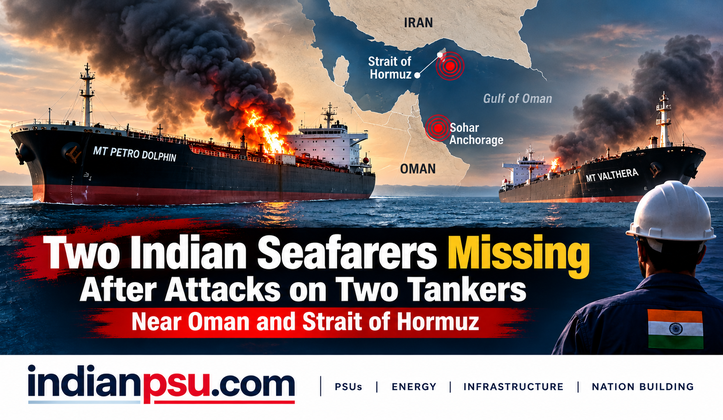
Two Indian seafarers remain missing after attacks on two commercial tankers in the Gulf region on October 11, triggering fresh concerns over the safety of merchant navy personnel and the security of vital international shipping routes.
The Nicaragua-flagged tanker MT Petro Dolphin was struck by a drone at Sohar Anchorage off Oman, leaving two of the 11 Indian seafarers aboard unaccounted for. Nine crew members were rescued and reported safe, while local Coast Guard search-and-rescue operations continued.
In a separate incident on the same day, the Marshall Islands-flagged tanker MT Valthera was hit by an unidentified projectile in the Strait of Hormuz, triggering a fire onboard. All 11 Indian seafarers aboard that vessel were reported safe, according to Union Minister for Ports, Shipping and Waterways Sarbananda Sonowal.
Search continues for two missing Indian seafarers
The two missing crew members were identified by the Forward Seamen’s Union of India (FSUI) as Bir Bahadur Yadav and Amit Singh.
The union has sought an urgent update on their whereabouts and called for continued rescue efforts, support for their families and stronger safeguards for seafarers operating in the region.
The Indian Embassy in Muscat said it was closely monitoring the Petro Dolphin incident and maintaining contact with the concerned authorities. Sonowal also confirmed that Indian authorities were coordinating with relevant agencies to support the search.
As of the latest reports reviewed, there was no confirmed announcement that the two missing seafarers had been located. Their status remains the immediate concern for the authorities and their families.
India condemns attacks on commercial vessels
The Ministry of External Affairs has condemned the attacks on the two vessels, warning that such incidents risk aggravating an already volatile regional situation.
India has called for immediate de-escalation and a resolution to the wider conflict through dialogue and diplomacy. It has also stressed that attacks on commercial vessels, seafarers and civilian infrastructure must cease.
The Indian Embassy in Muscat is coordinating with Omani authorities and the respective ship management companies to assist the missing seafarers and provide support to affected crew members.
The government’s response highlights the diplomatic and operational challenges involved when Indian nationals are caught up in maritime security incidents outside the country’s territorial waters.
Strait of Hormuz under renewed scrutiny
The attacks have renewed concerns about the security of commercial shipping around the Strait of Hormuz and the Gulf of Oman.
The Strait of Hormuz is a critical international energy corridor connecting the Persian Gulf with the Gulf of Oman and the Arabian Sea. It carries substantial volumes of crude oil, petroleum products and liquefied natural gas, making its security important for energy-importing countries, including India.
Repeated attacks or sustained threats to vessels in the region can disrupt shipping schedules, increase insurance and freight costs, and complicate the movement of essential energy supplies.
For India, the issue extends beyond trade and energy security. Indian seafarers form a significant part of the international merchant shipping workforce, and their safety depends on effective coordination among shipowners, flag states, coastal authorities and diplomatic missions.
A wider challenge for maritime safety
The two incidents involved separate vessels and different reported forms of attack. The circumstances surrounding the strikes, including who was responsible, have not been established in the reports reviewed.
The attacks nevertheless underline the vulnerability of civilian crews operating in a region affected by heightened tensions. Emergency preparedness, reliable communication channels and rapid search-and-rescue coordination remain critical to protecting seafarers.
For the families of the two missing Indians, the priority is clear: verified information about their whereabouts and every possible effort to locate them.
The immediate focus remains the search for the two missing crew members of MT Petro Dolphin. At the same time, the incidents have renewed calls for the protection of commercial shipping and the preservation of safe navigation through one of the world’s most important maritime corridors.