

CCL Officials Attacked: Who Protects Those Who Protect India’s Coal Assets?
Violence against inspection teams cannot become the new normal in India's coalfields
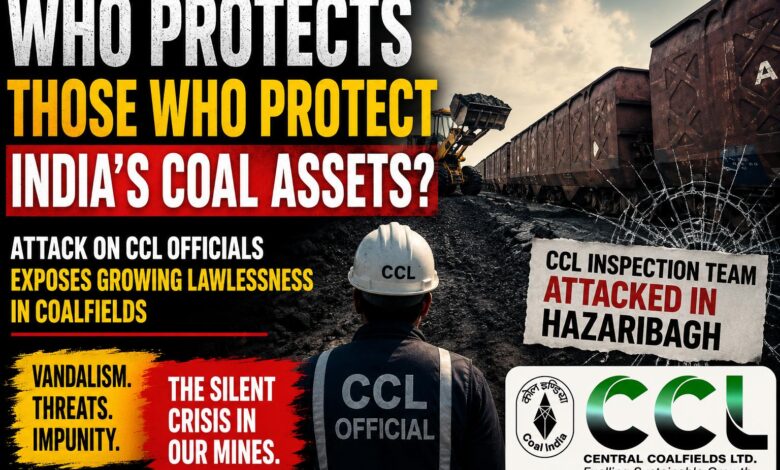
The shocking attack on a Central Coalfields Limited (CCL) inspection team in Jharkhand’s Hazaribagh is not merely an isolated incident of vandalism—it is a grim reminder of the deteriorating law and order situation in India’s coal belt. When officials entrusted with protecting national assets are attacked in broad daylight, official vehicles vandalised, and government employees threatened with death, the question that arises is both uncomfortable and urgent: Who protects those who protect the nation’s coal?
Coal remains India’s energy lifeline, powering nearly 70 percent of the country’s electricity generation. Every disruption in coal production has a cascading impact on power generation, industries, railways, and ultimately the economy. Yet, the officials responsible for ensuring smooth mining operations often find themselves confronting not just technical challenges but organised intimidation.
The alleged attack on CCL officials and security personnel during an inspection at the North Urimari Railway Siding is particularly disturbing because it reportedly occurred during an official inspection. If government officials cannot carry out routine inspections without facing violence, it reflects a serious erosion of the state’s authority in mining areas.
Such incidents are not new to India’s coalfields. Illegal mining, coal pilferage, transportation rackets, and local vested interests have long thrived in several mining belts. Whenever enforcement is tightened, resistance often turns violent. The targets are usually the very officers who attempt to enforce rules, plug leakages, or prevent illegal activities.
What makes the situation even more alarming is the apparent impunity with which such attacks are carried out. Vehicles are damaged, threats are issued, and official work is obstructed—yet these incidents rarely lead to swift convictions or lasting deterrence. This emboldens anti-social elements and sends a dangerous message that intimidation works.
For coal companies, the consequences extend far beyond damaged vehicles. Fear among officials can affect inspections, delay decision-making, weaken vigilance, and compromise operational discipline. No organisation can function effectively if its officers must weigh personal safety before performing official duties.
The attack also raises larger governance questions. Coal India Limited and its subsidiaries invest thousands of crores in modernisation, mechanisation, and safety improvements. But technology alone cannot overcome a breakdown of law and order. Operational excellence requires administrative confidence, and administrative confidence depends on robust security and effective policing.
The response must therefore go beyond registering an FIR. Those responsible should be identified quickly and prosecuted under stringent provisions for obstructing public servants and damaging government property. Sensitive mining locations require stronger police presence, better surveillance, and coordinated action between district administrations, state police, CISF, and coal companies.
India cannot afford a situation where organised elements dictate terms inside strategic mining areas. Every attack on a coal official is, in effect, an attack on national infrastructure and energy security.
The Hazaribagh incident should serve as a wake-up call—not only for Jharkhand but for every coal-producing state. Unless the rule of law is firmly established in mining regions, the nation’s coalfields risk becoming zones where fear replaces governance.
Officials who safeguard India's energy security deserve protection—not helplessness. The time for symbolic condemnation has passed. What is needed now is decisive action that restores the authority of the law and reassures every honest officer that the State stands firmly behind them.