
RINL in Freefall Mode: Coke Ovens Crippled, 1 Million Ton Coal Idle, Employees Allege Policy Failures Behind Deepening Crisis
Employees have expressed serious concern over what they describe as a lack of professional leadership at the top
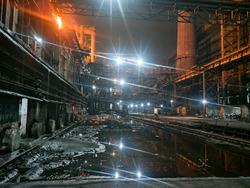
Rashtriya Ispat Nigam Limited (RINL), the corporate entity of Visakhapatnam Steel Plant, is reportedly facing one of the gravest operational crises in its history, with employees alleging a sharp deterioration in coke oven performance, an acute shortage of coke oven gas (COG), mounting raw material mismanagement and a series of policy decisions that have severely impacted steel production and the financial health of the public sector steelmaker.
According to employees, the crisis has disrupted the production of value-added finished steel, forcing the company to increasingly sell semi-finished steel products due to inadequate availability of coke oven gas. They claim this has resulted in substantial revenue losses and further aggravated the already fragile financial condition of RINL.
The concerns emerge even as employees describe the present situation as a “multi-organ failure stage” caused by years of operational decline, manpower depletion and what they characterise as flawed strategic and managerial decisions.
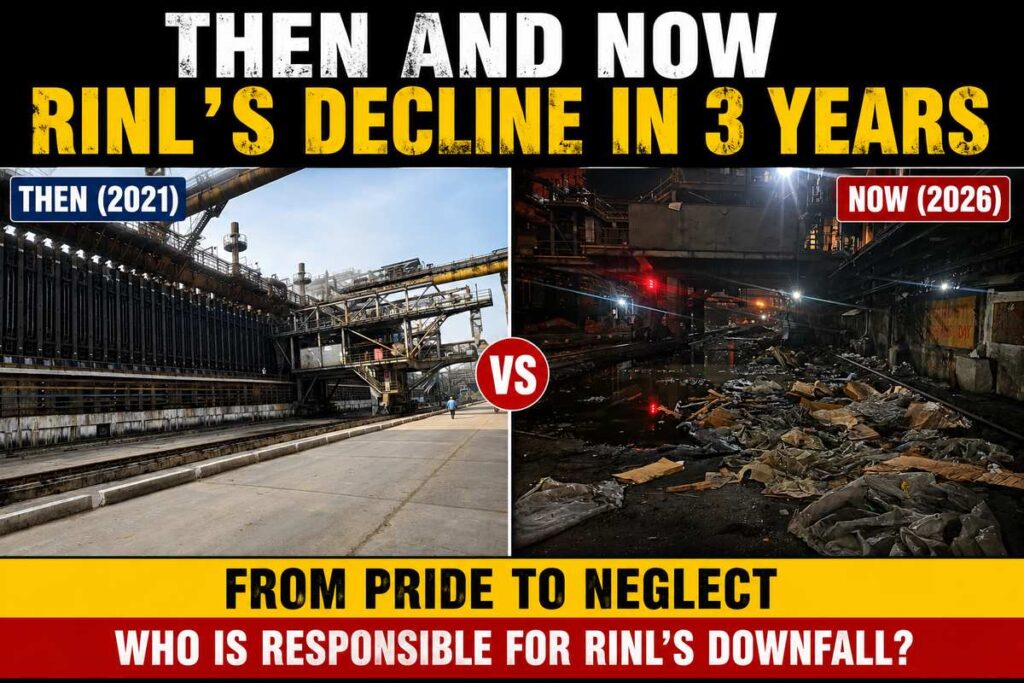
These photographs are a glaring testament to the neglect of RINL. Once hailed as the ‘Pride of Andhra Pradesh’, the steel plant now reflects a disturbing picture of deterioration. The dramatic contrast between the two images, captured at the same location just three years apart, speaks louder than words. Even more alarming, employees allege that despite the visible decline, there appears to be little urgency within the Ministry of Steel to arrest the downward slide of this national asset.
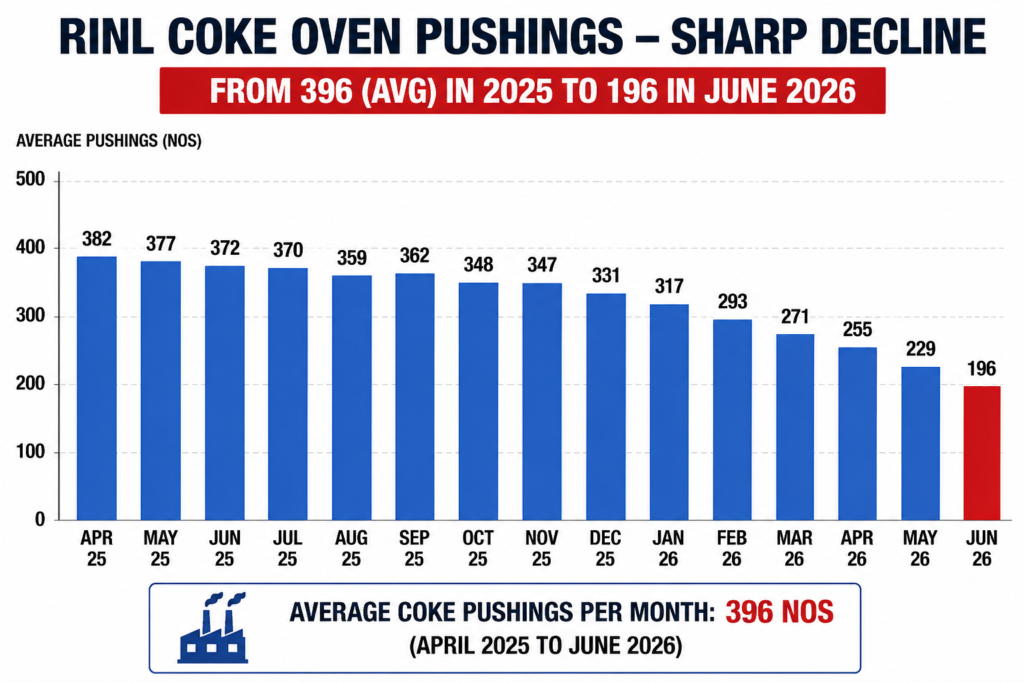
Coke Oven Performance Falls to Historic Lows
One Million Tonnes of Imported Coking Coal Reportedly Lying Idle
Employees have also raised serious questions regarding RINL’s raw material planning.
They claim that nearly one million tonnes of imported coking coal is currently lying unutilised at ports and storage yards even as the company continues purchasing expensive metallurgical coke from the market.
According to them, RINL has also struggled to find buyers for imported coal stored at port yards, further aggravating inventory accumulation and cash-flow pressures.
The current situation, employees allege, is characterised by:
- Sale of semi-finished steel because of inadequate coke oven gas.
- Nearly one million tonnes of imported coking coal lying unused.
- Heavy dependence on costly purchased metallurgical coke.
- Difficulty in disposing of imported coal stocks lying at ports.
- Continued deterioration in coke oven productivity.
Questions Over Procurement Strategy
Employees have questioned the rationale behind importing large quantities of premium coking coal if the deteriorating coke ovens were incapable of efficiently utilising it.
Their concerns have intensified after RINL recently offered 1.5 lakh tonnes of imported coking coal for sale through an MSTC e-auction.
According to employees, the development raises several questions.
If the plant’s declining coke oven performance was already evident, why was such a large quantity of imported coking coal procured at international prices?
If the coal can no longer be effectively consumed because of reduced coke oven capacity, why is it now being auctioned at lower prices, potentially resulting in substantial financial losses for an already cash-strapped public sector undertaking?
Employees believe these questions deserve clear answers from both the RINL management and the Ministry of Steel.
Employees Question Management Decisions
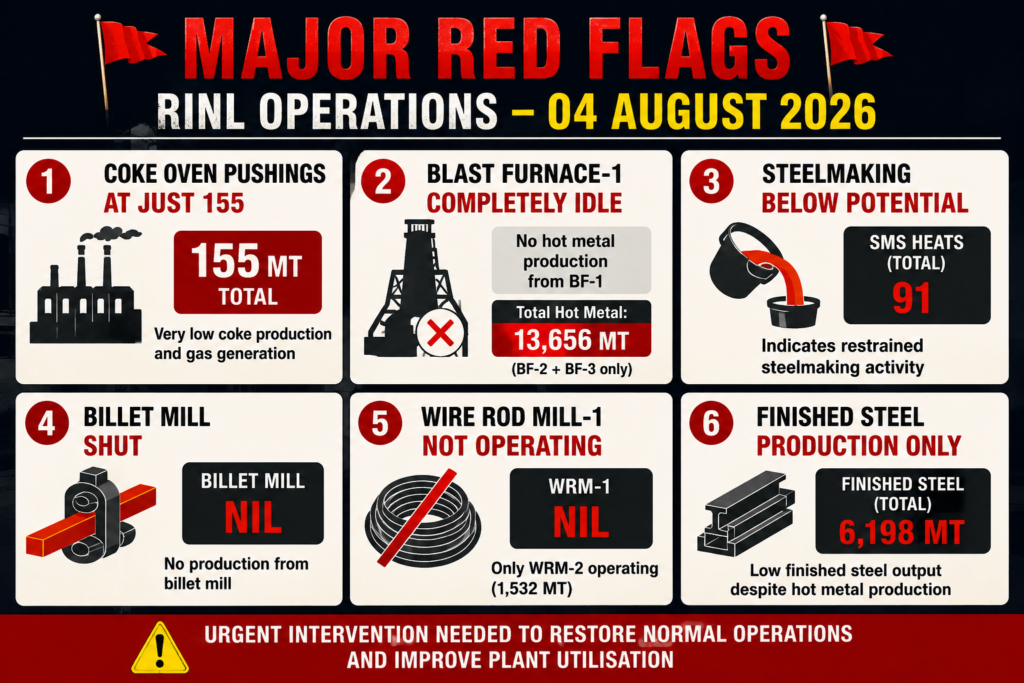
COG Shortage Hits Finished Steel Output
Employees allege that declining coke oven pushings have sharply reduced coke oven gas (COG) availability, restricting rolling mill operations. They claim only 55% of crude steel is currently being converted into finished steel, while the remaining 45% is being sold as semi-finished products at lower realisations, resulting in losses running into thousands of crores. RINL has not officially disclosed any such figures.
Coal Quality and Leadership Concerns
Employees have also questioned the use of higher sulphur, ash and phosphorus coal blends instead of premium hard coking coal, alleging it has adversely affected coke oven performance. They further claim that frequent transfers of experienced technical personnel, resignations and the absence of professional leadership have weakened operational decision-making. These allegations have not been independently verified, and RINL has not issued any official clarification.
HR Policies Under Fire
Employees attribute part of the crisis to the removal of nearly 4,000 contract workers, voluntary retirement schemes, transfers of experienced personnel and increased workload on the remaining workforce. They say these measures have created shortages in operations, maintenance and safety across critical production units.
Maintenance and Morale Decline
According to employees, manpower shortages have affected equipment maintenance, increasing operational risks and reducing plant reliability. They also claim employee morale has fallen sharply due to financial cuts, heavy workloads and growing pressure, with operational staff being held responsible for decisions taken at higher levels.
Operational Impact
Employees allege the crisis has led to:
- Reduced coke oven productivity and COG shortages.
- Only 55% conversion of crude steel into finished steel.
- Increased dependence on purchased metallurgical coke.
- Nearly 1 million tonnes of imported coking coal lying idle.
- Higher operating costs, maintenance challenges and declining employee morale.
To be continued…
We Report – You Decide