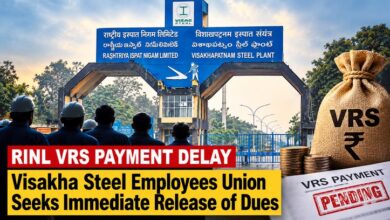

RINL: A Forgotten PSU or a Child of the Lesser Gods? VRS Employees Ask: If the Financial Condition Was the Problem, Why Were We Asked to Leave?
Was RINL’s VRS Offer a Trap to Reduce Staff Without Ensuring Timely Payment of Compensation?
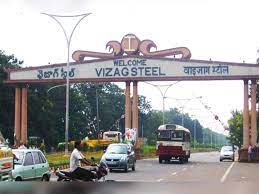
The controversy over the delayed payment of Voluntary Retirement Scheme (VRS) dues to former employees of Rashtriya Ispat Nigam Limited (RINL) is fast turning into a question of trust, contractual commitment and fairness.
Former RINL employees who opted for VRS and formally exited the company on September 30, 2025, are now questioning the logic behind the company’s reported decision to defer payment of their outstanding VRS benefits until its financial position improves.
Their question is simple but fundamental: If payment of the VRS compensation was always dependent on RINL’s future financial condition, why was that condition not clearly incorporated into the VRS terms when employees were asked to opt for the scheme?
The employees argue that they did not resign with an open-ended promise that their compensation would be paid whenever the company became financially comfortable. They opted for VRS on the basis of the terms and compensation structure communicated by RINL.
Was There a Financial-Condition Clause?
According to employees, the RINL VRS circular provides for compensation under the scheme based on the Gujarat pattern and Department of Public Enterprises (DPE) guidelines.
The compensation formula, as understood from the circular, provides for 35 days’ salary for every completed year of service and 25 days’ salary for every balance year of service.
Significantly, employees contend that there is no provision in the stated compensation formula making payment conditional upon RINL returning to profitability or its financial position improving in the future.
If the actual circular confirms this position, it raises a serious issue.
A VRS is not merely an informal assurance. Employees make an irreversible decision to leave their jobs based on the terms offered by the employer. Once they surrender their employment and complete the exit process, the compensation promised under the scheme becomes a central part of that transaction.
For the employees who left RINL on September 30, 2025, there was no going back.
The Employees’ Argument: We Would Not Have Left
The former employees’ argument is particularly pointed.
“If this condition was there, we would not have applied for VRS and resigned on September 30, 2025.”
That statement goes to the heart of the dispute.
Had employees been told clearly that a substantial portion of their VRS compensation would be payable only when RINL’s financial condition improved, many could have made a different decision about their future.
The issue, therefore, is not simply about delayed payment. It is about whether the terms on which employees surrendered their employment are now being retrospectively qualified by a condition that was not part of the original bargain.
RINL Has Already Secured a Substantial Wage Saving
There is another dimension that makes the employees’ grievance even more compelling.
Following the VRS exits, RINL has reportedly reduced its monthly wage burden by approximately ₹55 crore.
In other words, the employees who opted for VRS have already given up their salaries and employment. RINL, meanwhile, has obtained a substantial recurring reduction in its wage expenditure.
For employees who have exited, however, the financial obligations have not disappeared.
EMIs continue. Medical expenses continue. Children’s education continues. Household expenses continue.
For many former employees, the VRS compensation is not a discretionary payment or a bonus. It represents money that they expected to receive after making the life-changing decision to leave the organisation.
₹73 Crore: A Question That RINL Must Answer
The former employees are seeking immediate clearance of approximately ₹73 crore in pending dues.
The issue is not whether RINL faces financial challenges. Everyone understands that the steel industry is capital intensive and that RINL has faced serious financial pressures.
But financial difficulty cannot automatically become an open-ended justification for postponing a payment obligation—particularly when employees contend that no such condition formed part of the VRS terms.
Is RINL Becoming a “Child of the Lesser Gods”?
RINL’s employees and former employees have watched the company struggle for years.
The organisation has enormous strategic importance to Visakhapatnam and to India’s public-sector steel ecosystem. Yet the current VRS controversy is creating a perception among former employees that RINL has become a “forgotten PSU”—or, as some aggrieved employees bitterly describe it, a “child of the lesser gods.”
That perception deserves to be addressed.
A public sector enterprise is not merely a balance sheet. Its employees are stakeholders who have spent decades building the organisation.
If the government and the management expect employees to accept difficult decisions in the larger interest of the enterprise, the enterprise must also honour its commitments to those employees.
The Government Must Look Into the Matter
The dispute also raises a larger question for the Ministry of Steel and the Department of Public Enterprises.
If a VRS scheme is offered under established guidelines and employees surrender their employment in reliance upon its terms, can payment of the promised compensation subsequently be deferred indefinitely on the ground that the company’s financial position has not improved?
If there is a specific provision permitting such deferment, it should be placed in the public domain and explained to the affected employees.
If there is no such provision, then the government needs to ask why the former employees are still waiting for their dues.
Transparency is essential because these are not ordinary commercial employees negotiating with a private company. These are employees of a major Central Public Sector Enterprise who accepted a government-backed exit scheme.
Pay the Employees, Don’t Make Them Wait for a Miracle
The former employees are not asking for charity.
They are asking for payment of what they believe was promised to them under the VRS.
The demand is therefore straightforward:
RINL should immediately clear the pending VRS dues, along with applicable bank interest/compensation for the delay, and provide a transparent written explanation of the basis for withholding the payment.
The employees have already done their part. They left the organisation on September 30, 2025.
They surrendered their jobs.
RINL has already benefited from the consequent reduction in its monthly wage bill.
What remains is for the company to honour the other side of the bargain.
Because if a PSU can ask its employees to trust a VRS scheme when asking them to leave, those employees should be able to expect the PSU to honour that trust when it comes to paying them.
The question before RINL is no longer merely when it will pay its former employees. The bigger question is: Why should employees who relied on the VRS terms have to wait for RINL’s financial condition to improve when no such condition was part of the bargain?