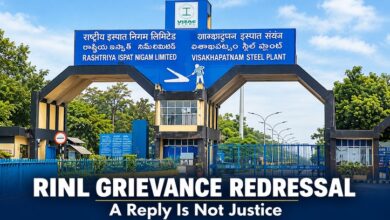

RINL Creates History of Sorts with CISF Exit from Visakhapatnam Steel Plant
1,331 CISF posts covering Security and Fire Wings to be withdrawn after three-month notice, with withdrawal scheduled for November 17
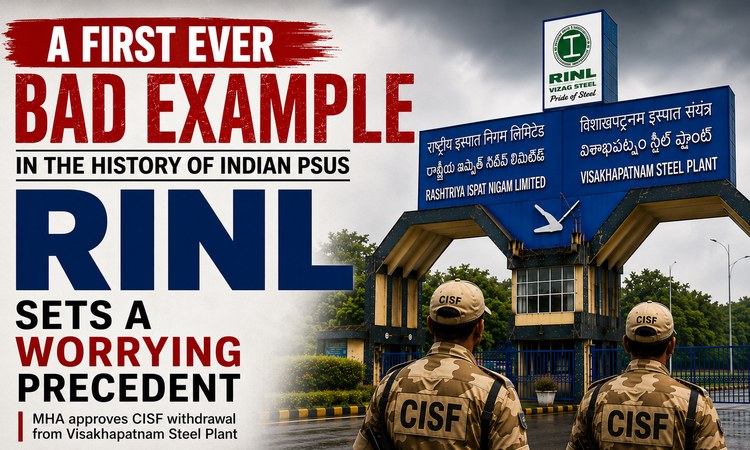
Rashtriya Ispat Nigam Limited (RINL) is set to create history of sorts with the exit of the Central Industrial Security Force (CISF) from its Visakhapatnam Steel Plant (VSP), following approval from the Ministry of Home Affairs (MHA).
The decision involves the withdrawal of 1,331 sanctioned CISF posts from the steel plant, comprising 1,033 Security Wing posts and 298 Fire Wing posts. The withdrawal is scheduled to take effect from November 17, 2026, after completion of the prescribed three-month notice period.
The development assumes particular significance as it represents the first-ever complete exit of CISF from a PSU, marking a major departure from the established system under which the central force provides security and fire protection at major public sector industrial establishments.
MHA approves CISF withdrawal
The Ministry of Home Affairs approved the withdrawal through its communication dated August 18, 2026. Following the approval, CISF has initiated the formal process for withdrawing its personnel from VSP.
The August 21 communication directs the concerned authorities to take necessary action under Section 14(2) of the CISF Act and complete the withdrawal after the three-month notice period.
The order covers both components of CISF’s deployment at VSP — the Security Wing and Fire Wing.
This means the move is not simply a reduction in CISF strength or a restructuring of deployment. It entails the withdrawal of the sanctioned CISF establishment covering security as well as fire duties at the plant.
1,331 posts to be withdrawn
The numbers underline the scale of the decision:
Security Wing: 1,033 posts
Fire Wing: 298 posts
Total: 1,331 posts
The withdrawal is to be completed on November 17, 2026, giving RINL and the concerned authorities a three-month window to complete the necessary arrangements.
RINL asked to clear CISF dues
The MHA communication has also directed that outstanding dues payable by RINL to CISF be cleared.
CISF has been asked to ensure recovery of pending dues from the RINL management. After the withdrawal, CISF will submit a compliance report along with a No-Dues Certificate from the Sector Inspector General.
The No-Dues Certificate is required for processing the abolition of the sanctioned Security Wing and Fire Wing posts, as envisaged in the MHA approval.
A major departure from the PSU security model
CISF has for decades been an integral part of the security architecture of India’s major public sector enterprises and critical industrial installations.
The force’s role has extended beyond conventional security to include access control, protection of sensitive installations, perimeter security and fire protection at several major industrial establishments.
Against this backdrop, the complete withdrawal of CISF from VSP represents a significant departure from the conventional PSU security model.
The VSP case is particularly notable because both the Security Wing and Fire Wing are being withdrawn, rather than only a partial reduction in deployment.
What will replace CISF at VSP?
The official communications approving the withdrawal do not specify the alternative security or fire-safety arrangement that will take effect after November 17.
That will therefore be an important issue for RINL as the withdrawal date approaches.
With more than 1,300 CISF posts being withdrawn, the transition will require arrangements for security of the sprawling integrated steel plant as well as fire and emergency response responsibilities presently covered by the CISF deployment.
The official communication is focused primarily on the withdrawal process, recovery of outstanding dues and subsequent abolition of the sanctioned CISF posts.
Why the RINL development matters
The significance of the decision extends beyond the boundaries of Visakhapatnam Steel Plant.
For RINL, the withdrawal marks the beginning of a new security regime at one of India’s major integrated steel plants.
For CISF, it represents the closure of a major PSU deployment involving 1,331 sanctioned positions.
And for the wider public sector, the development could prompt questions about the future pattern of CISF deployment at industrial establishments and the circumstances under which such security arrangements may be withdrawn.
The CISF exit from VSP is thus more than an administrative exercise. It marks a significant change in the security architecture of a major PSU and puts RINL at the centre of an unprecedented development in the country’s public sector security framework.
With November 17 now set as the withdrawal date, all eyes will be on how RINL manages the transition and what security and fire-protection mechanism replaces the CISF deployment at Visakhapatnam Steel Plant.