
RINL Saves Over ₹500 Crore Annually Through VRS, Then Why Delay ₹75 Crore in VRS Dues?
Visakha Steel Employees Union General Secretary Padi Trinath Rao appeals to Cabinet Secretary and PMO for immediate release of VRS package and EL encashment
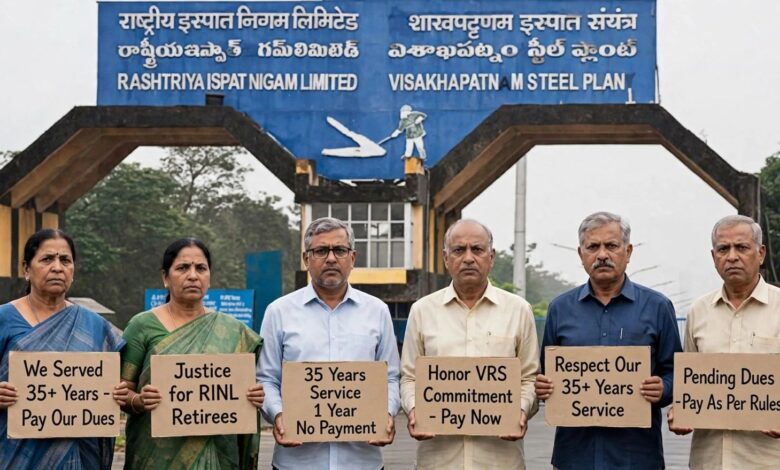
“Money saved is money earned,” goes the old saying. But in the case of RINL, confusion appears to rule the roost.
A fresh complaint over the implementation of the Voluntary Retirement Scheme (VRS) at Rashtriya Ispat Nigam Limited (RINL), the corporate entity that operates Visakhapatnam Steel Plant (VSP), has reached the Cabinet Secretary and the Prime Minister’s Office.
Padi Trinath Rao, General Secretary of the Visakha Steel Employees Union, has raised a complaint through the Centralized Public Grievance Redress and Monitoring System (CPGRAMS), questioning why RINL is delaying payment of the VRS package and earned leave (EL) encashment to employees who opted for voluntary retirement.
According to Rao, the total outstanding amount involved is around ₹75 crore, while the reduction in RINL’s wage bill following VRS is estimated at approximately ₹60 crore per month.
That translates into an annual saving of more than ₹500 crore, he pointed out, raising a fundamental question: if the company is saving more than ₹500 crore every year because of VRS, why should payment of a much smaller amount owed to VRS optees be delayed?
‘VRS was introduced when RINL was in financial distress’
Rao has argued that the VRS exercise was introduced when RINL was facing severe financial difficulties and formed part of the Government of India’s ₹11,440-crore revival package for the steel company.
The VRS was among the measures linked to the revival effort, and employees with more than 35 years of service opted for retirement under the scheme, he said.
“These employees made sacrifices at a critical stage and helped RINL secure the revival package,” Rao has contended.
The union leader has therefore questioned the logic behind linking payment of the VRS settlement to a future improvement in RINL’s financial position.
‘How can payment be linked to a good financial position?’
Rao said employees are reportedly being given a standard response through CPGRAMS that the VRS amount will be paid after the company’s financial position improves.
He has questioned the legal and policy basis of such a condition.
His central argument is straightforward: if VRS was implemented precisely when the company’s financial position was poor, how can payment of the benefits promised under the scheme subsequently be made conditional upon RINL returning to a good financial position?
Rao has also sought clarification on whether there is any provision in the Department of Public Enterprises (DPE) guidelines or RINL’s VRS policy that permits the company to indefinitely defer payment of the VRS package and EL encashment on the ground of financial difficulties.
Appeal to Cabinet Secretary and PMO
The union leader has appealed to the Cabinet Secretary and the PMO Public Grievance Officer to scrutinize the matter and examine whether RINL’s response is consistent with the applicable VRS policy and Government guidelines.
Rao has also raised concerns over the manner in which grievances filed through CPGRAMS are being handled.
He alleged that instead of independently examining the relevant policy provisions, RINL’s response is being reproduced and the grievance subsequently closed.
The union has sought intervention at the highest level to ensure that the policy position is examined before the grievances are disposed of.
VRS families facing financial pressure
The issue has assumed significance because many of the employees who opted for VRS are now senior citizens, with several reportedly aged 58 years and above.
Rao said the delayed payments are creating difficulties for families dealing with housing EMIs, higher-education loans, medical expenses of elderly parents and children’s marriages, among other financial commitments.
For these employees, the pending VRS package and EL encashment are not merely accounting entries but amounts that were expected as part of their retirement settlement.
The larger question for RINL
The dispute now puts a larger question before RINL and the Government: Can a company defer a committed VRS-related payment indefinitely merely by citing its financial condition, particularly when the VRS itself was introduced as part of a financial revival exercise?
Rao has urged the Cabinet Secretary and PMO to examine the relevant policy documents, determine whether the delay is permissible, and, if not, direct RINL to release the pending VRS package and EL encashment immediately.
For the VRS optees and their families, the issue is now about more than the approximately ₹75 crore reportedly pending. It is about whether employees who accepted voluntary retirement in the interest of the company’s revival can reasonably be asked to wait indefinitely for the benefits associated with that decision.