

Government Grievance Redressal Needs an Overhaul: A Reply Is Not Justice
Can a grievance be considered resolved merely because the department concerned has furnished a reply?
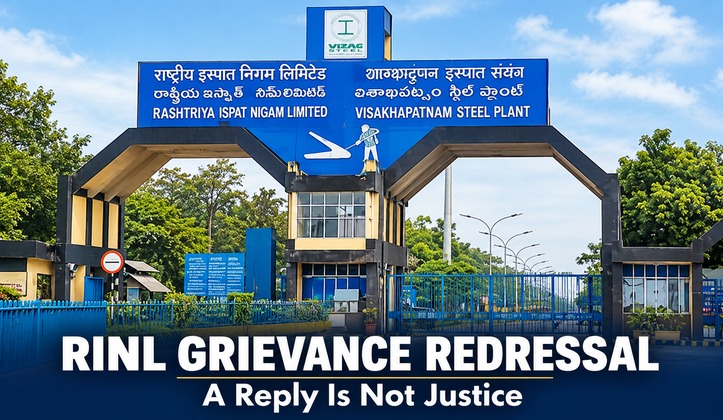
OPINION PIECE BY VASA SRINIVASA MURTHY, Ex-DGM (HR), RINL (Visakhapatnam Steel Plant)
When complaints are referred to the very departments against which they are made, and appeals are disposed of by endorsing departmental replies, the credibility of the grievance redressal system comes under scrutiny.
India’s public grievance redressal mechanism was conceived to provide citizens with an effective avenue for justice when administrative authorities fail to address legitimate concerns. The facility to approach the Prime Minister’s Office (PMO) carries particular significance because citizens expect such escalation to bring independent scrutiny, accountability and meaningful relief.
Yet a fundamental question demands attention: Can a grievance be considered resolved merely because the department concerned has furnished a reply?
My experience of more than 38 years in public sector service, coupled with cases involving retired employees and pensioners, suggests that the distinction between disposing of a grievance and actually resolving it needs urgent examination.
The problem is not that the PMO or the Central Government’s grievance machinery seeks explanations from the departments concerned. That is a necessary administrative step. The problem arises when the departmental response is accepted as sufficient without adequately examining the complainant’s objections, supporting documents or the substance of the original grievance.
In such circumstances, the system risks becoming a mechanism for validating administrative responses rather than delivering justice.
When the Department Becomes the Judge of Its Own Conduct
A recurring pattern in grievance redressal is straightforward. A citizen raises a complaint against an organisation. The grievance is forwarded to that organisation for comments. The organisation submits its response, following which the grievance is closed. If the complainant challenges the decision, the appeal may also be disposed of on the ground that the original response was in order.
The citizen receives a reply, but the underlying problem may remain unresolved.
This raises serious questions about the effectiveness of appellate review, particularly when the dispute concerns unpaid retirement benefits, medical reimbursements or pension calculations. These are not abstract administrative disagreements. They can have direct and lasting consequences for the financial security and dignity of citizens.
Three cases illustrate why the grievance redressal mechanism needs a more substantive and accountable approach.
1. RINL VRS Compensation: Instalments Do Not Settle the Entire Claim
In the case of Shri Padi Trinadha Rao, an order issued by the Ministry of Steel on 12 October 2026 concerning voluntary retirement scheme (VRS) compensation recorded RINL’s decision to release the outstanding amount in six monthly instalments beginning on 1 October 2026. The order also noted that the first instalment had been released. On this basis, the grievance officer’s reply was held to be in order and the appeal was disposed of.
But does the release of one instalment establish that the grievance has been fully addressed?
The central concern was the prolonged non-payment of compensation due to a retired employee. A decision to pay in instalments may represent progress, but it does not settle the entire outstanding liability. Nor does it, by itself, explain why the payment was delayed for so long or what safeguards exist to ensure that the remaining instalments are released on schedule.
The appellate process offered an opportunity to examine these questions. Merely endorsing the departmental response risks confusing a proposed remedy with completed redressal.
For a retiree who has served a public sector enterprise, legitimate compensation should not become an indefinite exercise in administrative follow-up.
2. Post-Retirement Medical Reimbursement: Financial Constraints Cannot Be the Final Answer
Another reported case concerns a retired RINL employee whose family member underwent major heart surgery involving expenditure exceeding ₹20 lakh.
According to the case presented, the retiree was covered by a post-retirement medical scheme under which 80 per cent of eligible expenditure was reimbursable, subject to examination by a screening committee.
Despite prolonged non-settlement of the claim, grievances submitted through Central Government and PMO portals were reportedly closed after the organisation cited financial difficulties or a lack of funds. The appeal, too, met the same fate.
Financial constraints may be genuine, particularly in a public sector enterprise facing economic difficulties. However, citing a shortage of funds does not, by itself, determine whether a claim is admissible, establish the amount payable under the applicable scheme or provide a credible schedule for settlement.
These are separate questions that deserve clear answers.
Was the claim examined in accordance with the applicable rules? What amount was found admissible? If payment was delayed because of financial constraints, what steps were being taken to settle the liability, and within what timeframe?
For a retired employee who has already incurred substantial expenditure on life-saving treatment, an administrative reply that leaves these questions unanswered offers little practical relief.
A medical reimbursement claim cannot be treated as resolved simply because the organisation has explained why it has not paid.
3. Pension Computation: Where Does the Pensioner Go for an Independent Review?
The problem is not confined to RINL. A pensioner’s grievance concerning pension computation by an EPFO field office raises a similar concern. In this instance, the grievance relates to my own pension computation.
I had sought certain documents from the field office to understand and verify the basis on which my pension had been calculated. The specific request for supporting documents, however, was not addressed in the manner expected.
The grievance was reportedly referred back to the same field office. The office submitted its reply on the grievance portal, after which the Central Grievance Officer treated the response as sufficient and closed the matter. The appeal reportedly met the same fate.
The fundamental issue here is not merely whether the field office has submitted a response. It is whether the pensioner’s request for the documents supporting the computation has been addressed and whether the calculation can be independently verified.
If a citizen questions a calculation and asks for the underlying records, the grievance cannot be meaningfully resolved without addressing that request.
More importantly, when the original office’s response is disputed, the appellate mechanism should examine whether the specific objections have been answered. Otherwise, the pensioner is left going around in circles, with no clear avenue for obtaining a reasoned determination.
The Principle of Natural Justice Cannot Be Reduced to a Formality
The principle of nemo judex in causa sua—no one should be a judge in their own cause—is a fundamental tenet of natural justice.
A department must, of course, be given an opportunity to explain its actions and place relevant facts on record. But its explanation should be treated as material for examination, not automatically as the final determination of the dispute.
The concern becomes particularly acute when the complainant identifies specific omissions, challenges the factual basis of the response or seeks documents that would permit independent verification.
An effective grievance redressal system must distinguish between accepting a departmental explanation and establishing that the explanation adequately answers the complaint.
This does not mean that every grievance requires a formal judicial inquiry. Nor does it mean that the PMO must personally investigate every complaint. It means that the authority responsible for review should independently assess the material issues before deciding that a grievance has been resolved.
A departmental reply is evidence of the department’s position. It is not, by itself, proof that the department is right.
An Appellate Authority Must Do More Than Endorse the Original Reply
An appeal is not supposed to be a second administrative formality. Its purpose is to provide an opportunity to correct an error, address an omission or reconsider a decision that the complainant believes to be unjustified.
The appellate authority should therefore adopt an independent and objective approach. In substance, this calls for reasoned consideration of the facts, the applicable rules, the records available and the objections raised by the appellant.
Where a claim concerns unpaid dues, the authority should establish, wherever the records permit, the amount outstanding, the action required for settlement and the timeline for completion. Where the dispute concerns pension computation, the calculation and its supporting basis should be explained. Where a medical reimbursement claim remains pending, the admissibility of the claim and the reasons for non-payment should be clearly determined.
A speaking order—one that records the material issues considered and explains the reasons for the conclusion—is essential to meaningful review.
The appellant may not always receive a favourable decision. But the appellant should at least receive a reasoned decision that demonstrates that the objections have been considered on their merits.
Seven Reforms to Make Grievance Redressal Effective
The Central Government’s grievance redressal mechanism needs to move beyond disposal statistics and focus on the quality of outcomes. The following reforms deserve serious consideration.
1. Independent examination of disputed grievances
Where a complainant raises substantial objections to a departmental response, the appeal should, wherever practicable, be examined by an authority independent of the original decision-maker. At the very least, the reviewer must independently assess the facts and the merits of the objections.
2. Reasoned and speaking orders
Closure orders should address the principal issues raised by the complainant, identify the relevant rules and records, and explain why the grievance is considered resolved or rejected. A standard response stating that the departmental reply is in order should not suffice where material objections remain unanswered.
3. Time-bound resolution, not merely time-bound replies
The system should distinguish between the time taken to submit a response and the time required to resolve a grievance. Where an issue cannot be settled within the prescribed period, the reasons for the delay and a realistic timeline for completion should be communicated.
4. Accountability for repeated delays and ineffective responses
Repeated complaints, evasive replies, unsuccessful appeals and prolonged non-payment should trigger supervisory scrutiny. The objective should be to identify the cause of the continuing dispute and ensure corrective action, rather than repeatedly closing the same issue.
5. Greater sensitivity towards retirees and medical emergencies
Retirement benefits, pension payments and medical reimbursements often have a direct bearing on a person’s financial stability. Genuine hardship, particularly in cases involving major medical treatment, should receive due consideration within the applicable rules.
6. Clear remedies and monitoring of compliance
Where a grievance is found justified, the order should specify the corrective action required and a definite timeline, wherever feasible. The system should also monitor whether the promised action has actually been completed. An assurance of future payment should not automatically be equated with payment.
7. Outcome-based performance assessment
The performance of grievance redressal authorities should not be measured merely by the number of complaints disposed of or the speed with which they are closed. The assessment should also consider whether legitimate claims were settled, material objections were addressed and corrective action was implemented.
A high disposal rate may look impressive on paper. It means little to a pensioner whose claim remains unresolved.
The PMO Must Ensure That Escalation Leads to Meaningful Scrutiny
The PMO and the Central Government’s grievance redressal machinery cannot be expected to personally adjudicate every dispute involving every department and public sector enterprise. Their role, however, must extend beyond forwarding petitions and accepting departmental replies.
When a grievance is escalated to the highest levels of government, the citizen should have reasonable grounds to expect that the complaint will receive meaningful consideration. If the departmental response fails to address the central issue, the matter should be returned for a specific explanation or subjected to further independent review, as appropriate.
This is particularly important when the complainant has identified a clear omission, requested supporting documents or demonstrated that the promised remedy has not been completed.
The objective is not to bypass departmental authorities or presume that every complaint is justified. It is to ensure that legitimate complaints are examined fairly and that the authorities responsible for addressing them are held accountable for the quality and completeness of their responses.
Having served in the public sector for more than 38 years, I am concerned that a system in which departmental responses are routinely accepted without meaningful scrutiny may inadvertently encourage administrative complacency. If an organisation knows that its reply is likely to secure closure even when the complainant disputes it on specific grounds, the incentive to resolve the underlying problem may weaken.
That would defeat the purpose for which the grievance redressal mechanism was established.
Conclusion: The Real Measure Is Justice Delivered
For retired employees, unpaid compensation, delayed pension benefits and unresolved medical reimbursements are not matters of administrative convenience. They affect financial security, dignity and peace of mind after years of public service.
The government must therefore ensure that its grievance redressal mechanism functions as an instrument of substantive justice rather than a system for recording replies and closing files.
The essential reform is neither complicated nor unreasonable: give departments the opportunity to explain their decisions, but ensure that disputed explanations are independently examined; require appellate authorities to record reasoned conclusions; and monitor whether promised corrective action has actually been completed.
A grievance should not be considered resolved merely because an officer has responded, a portal entry has been updated or an appeal has been disposed of.
The ultimate test of grievance redressal is not how many complaints the government closes, but how many legitimate grievances it actually resolves.
That is the standard by which the credibility of public administration must ultimately be judged.
Opinion expressed here are those of VASA SRINIVASA MURTHY, Ex-DGM (HR), RINL – Visakhapatnam Steel Plant