

Midnight Raids on Employees: Is RINL Management Still Living in the British ‘Danda Raj’?
One is forced to believe - has the "Second Emergency" been imposed within Vizag Steel and what is the Ministry of Steel doing about this?
Read in your preferred Language :
Editor’s Note – Usually I tend to write my editorial opinion at the end, but this piece of news has made me start this article –
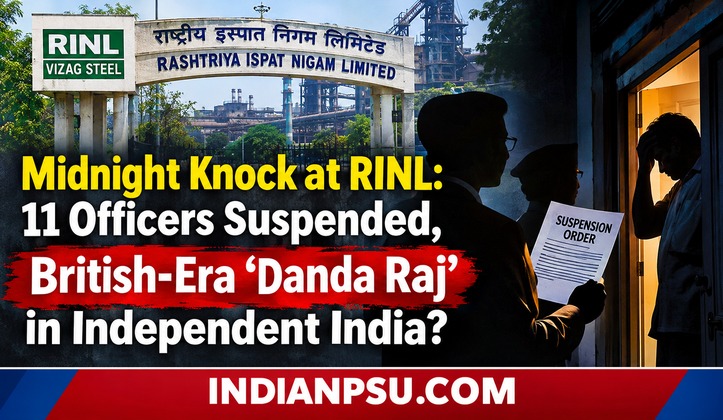
I thought we were living in an independent country of our own, where every citizen is entitled to dignity, respect and fair treatment. But the reported midnight suspension of 11 officers at Rashtriya Ispat Nigam Limited (RINL), reportedly in the presence of their family members, raises an uncomfortable question: Has the RINL Management still not shed the mindset of the British-era ‘Danda Raj’?
Discipline and accountability are essential in any organisation. But does enforcing discipline require humiliating employees and their families in the middle of the night? Is this how a public sector enterprise expects to build employee confidence and organisational commitment?
India became independent decades ago. It is time that institutional mindsets, too, moved on from the colonial culture of intimidation and unquestioned authority. A midnight police raid on officials is not only baffling but can simply be termed into an act of humiliation and cruelty. It is high time that the Prime Minister Office should look into this unjust and inhuman act!
Before we reveal the whole story, I would like to raise some questions-
- Who issued these orders?
- CMD of RINL?
- Or these orders were issued from someone sitting in New Delhi?
But whatever the case may be, employees and family members of RINL employees and executives have all the right to know the name of the person/persons, responsible for this fiasco.
Mr. Vasa Srinivasa Murthy, Retd. DGM (HR), RINL, Visakhapatnam Steel Plant reported midnight suspension of 11 officers of Rashtriya Ispat Nigam Limited (RINL), following production losses in the Rolling Mills, has triggered serious questions over the management’s approach to disciplinary action, professional HR practices and employee dignity.
In a strongly worded critique, Vasa Srinivasa Murthy, a former RINL HR and Vigilance official, has questioned the circumstances under which suspension orders were reportedly served at the residential quarters of the officers around midnight, allegedly in the presence of their family members. Their identity cards were also reportedly taken away.
Murthy, who served RINL for 38 years, including more than 11 years in the Vigilance Department, has made it clear that he does not oppose disciplinary action against officers responsible for negligence or dereliction of duty. However, he questions whether the manner in which the action was reportedly implemented was necessary or consistent with established HR practices.
Why were suspension orders served at midnight?
Questioning the urgency behind the exercise, Murthy argues that the orders could have been served at the workplace when the officers reported for their respective shifts the following day.
He has questioned whether there was any apprehension that the officers might disappear, tamper with records or interfere with an investigation that warranted such an extraordinary procedure.
According to him, in the absence of compelling circumstances, serving suspension orders at residential premises in the middle of the night, particularly before family members, could amount to an unnecessary and humiliating exercise.
What do RINL’s CDA Rules say?
Drawing attention to RINL’s Conduct, Discipline and Appeal (CDA) Rules, Murthy has referred to Rule 21, which empowers the competent authority to suspend an employee when criminal proceedings are under investigation or trial, or when disciplinary proceedings are contemplated or pending.
However, he points out that Rule 36, dealing with the service of orders and notices, provides for personal service on the employee or communication through registered post at the employee’s last known address.
According to Murthy, the rules do not prescribe midnight service of suspension orders at an employee’s residence as a special or necessary procedure.
He argues that the authority to suspend an employee and the manner in which that authority is exercised are two different matters. The existence of disciplinary powers cannot justify an unnecessarily humiliating method of implementation.
Suspension is not a declaration of guilt
Murthy has also reminded the management that suspension is an interim administrative measure and not a punishment or a declaration of guilt.
Its purpose is to facilitate an impartial investigation and protect the organisation’s interests wherever necessary.
He cautions that suspension should not become a public demonstration of authority or create an impression that the employee has already been found guilty.
The psychological impact of serving suspension orders at midnight, in front of family members, cannot be ignored, he argues. Such incidents can cause anxiety, embarrassment and considerable emotional distress to employees and their families.
Is RINL confusing stronger HR with greater disciplinary power?
Perhaps the most significant observation in Murthy’s critique concerns the changing character of RINL’s HR function.
Recounting an earlier conversation with a junior HR colleague who claimed that HR had become stronger than ever, Murthy argues that issuing charge-sheets and suspension orders cannot, by themselves, be regarded as indicators of an effective HR department.
He acknowledges that in earlier years, strong collective bargaining by employees, workmen and executive associations sometimes constrained disciplinary action. However, he points out that the organisation was then financially healthier and operationally stronger.
The situation today is markedly different.
RINL is struggling with operational and financial constraints, delays in salary payments, curtailment of benefits and other difficulties. Despite these challenges, employees continue to keep the plant running through their commitment and resilience.
Against this backdrop, Murthy questions whether the apparent strengthening of HR is actually a consequence of the changed organisational environment and the weakening of employees’ collective bargaining position.
He argues that the real strength of HR should be measured by its ability to ensure organisational performance, industrial harmony, employee confidence and accountability through fairness and professional competence.
Accountability must extend to every level
Murthy has also emphasised that officers must be held accountable for production losses, provided responsibility is properly established and they are given an opportunity to defend themselves.
However, accountability cannot be selective.
He maintains that responsibility must extend to supervisory and managerial levels as well, rather than being confined to employees at the operational level.
A warning to RINL management
In his concluding observations, Murthy urges the RINL management to introspect whether the procedure adopted in the present instance was necessary, whether it was consistent with the spirit of the CDA Rules and whether the same objective could have been achieved through a more dignified process.
His central argument is that disciplinary authority must not become a demonstration of institutional power at the cost of individual dignity.
As he puts it, an organisation can be firm without being insensitive, disciplined without being intimidating and accountable without humiliating its employees.
“Discipline without dignity is not good management. It is merely the exercise of authority.”
The report is based on inputs given to us by Mr. Vasa Srinivasa Murthy, Retd. DGM (HR), RINL, Visakhapatnam Steel Plant.
We Report, You Decide…