
₹42,391 Crore Pension Liability, ₹315 Crore Investment Loss: Coal Miners’ Pension Scheme Under Accountability Scanner
CAG findings, PAC recommendations and ₹42,391.63-crore actuarial liability put CMPS-1998 under fresh scrutiny

Three decades after CMPS-1998 came into force, CAG findings, PAC recommendations and pensioners’ demands put the spotlight on actuarial sustainability, investment governance and delayed reform.
The Coal Mines Pension Scheme (CMPS)-1998, intended to provide financial security to retired coal miners and their families, is once again facing questions over accountability, pension sustainability and the pace of reforms.
An infographic released by the All India Association of Coal Pensioners (AIACP) has brought together findings attributed to the Comptroller and Auditor General of India (CAG), the Public Accounts Committee (PAC) and Ministry of Coal records, highlighting what it describes as an “unfinished reform” of the coal miners’ pension system.
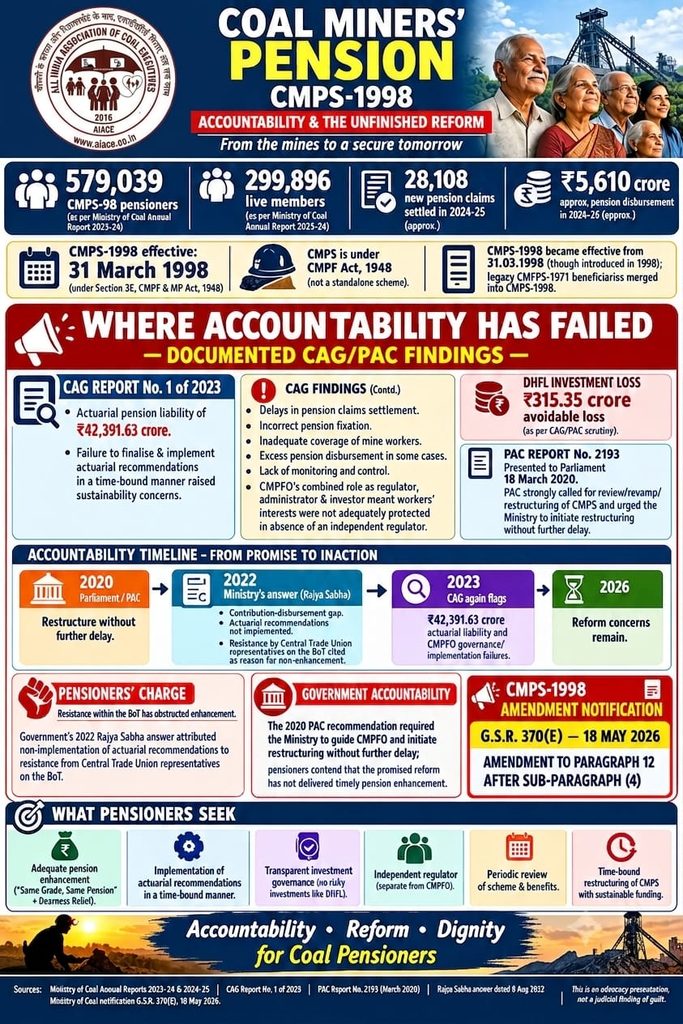
According to the figures cited in the presentation, CMPS-1998 covers 5,77,039 pensioners and 2,99,896 live members. Around 28,108 new pension claims were reportedly settled during 2024-25, while approximately ₹5,610 crore was disbursed towards pensions in 2024-25.
CAG flags ₹42,391.63 crore actuarial liability
One of the central issues highlighted is the actuarial position of the pension scheme.
The infographic cites CAG Report No. 1 of 2023 as putting the actuarial pension liability at ₹42,391.63 crore. It also points to the failure to finalise and implement actuarial recommendations within a time-bound manner, despite concerns over the long-term sustainability of the scheme.
The CAG-related findings cited in the presentation also include:
- delays in settlement of pension claims;
- incorrect pension fixation;
- inadequate coverage of mine workers;
- excess pension disbursement in some cases; and
- inadequate monitoring and control.
The presentation further raises questions about the institutional structure governing CMPS, pointing out that the Coal Mines Provident Fund Organisation (CMPFO) performs the roles of regulator, administrator and investor, potentially creating concerns regarding independent oversight.
₹315.35 crore DHFL investment loss highlighted
Another major issue concerns investments made from pension-related funds.
The AIACP presentation cites a ₹315.35-crore avoidable loss in investments in DHFL, attributing the finding to the CAG’s examination of pension fund security.
The issue assumes significance because pension funds involve the retirement savings and future financial security of thousands of former coal workers and their families.
PAC had called for restructuring in 2020
The presentation also refers to PAC Report No. 2193, presented to Parliament on 18 March 2020.
According to the material circulated by the pensioners’ association, the PAC had called for a review/revamp of the CMPS and urged the Ministry of Coal to initiate restructuring without further delay.
The timeline presented by AIACP shows 2020 as a key point when Parliament/PAC called for restructuring, followed by a 2022 Ministry response and another CAG flagging of the actuarial liability and implementation issues in 2023.
The pensioners’ association argues that the reform process has not produced the desired enhancement of pension benefits within the expected timeframe.
Contribution-disbursement gap remains a concern
The presentation also refers to a contribution-disbursement gap and the Ministry of Coal’s response in the Rajya Sabha.
It says the Ministry had attributed non-implementation of certain actuarial recommendations to resistance from Central Trade Union representatives on the Board of Trustees.
That explanation has itself become part of the accountability debate, with pensioners questioning whether prolonged institutional differences should delay measures intended to address the financial sustainability and adequacy of pensions.
CMPS-1998: Nearly three decades of the scheme
The Coal Mines Pension Scheme, 1998 came into effect from 31 March 1998 under the framework of the Coal Mines Provident Fund and Miscellaneous Provisions Act, 1948.
The scheme has therefore been operating for nearly three decades. The pensioners’ association is now demanding that the next phase should focus on structural reform rather than periodic administrative adjustments.
The infographic also refers to an amendment notification issued by the Ministry of Coal — G.S.R. 370(E), dated 18 May 2026 — concerning an amendment to Paragraph 12 of CMPS-1998.
What pensioners are demanding
The demands highlighted by AIACP go beyond an immediate increase in pension.
The association has sought:
- Adequate pension enhancement, including consideration of a “same grade, same pension” principle and dearness relief;
- Time-bound implementation of actuarial recommendations;
- Transparent investment governance, including stronger safeguards around pension fund investments;
- An independent regulator, separate from CMPFO;
- Periodic review of the pension scheme and benefits; and
- Time-bound restructuring of CMPS with sustainable funding mechanisms.
The larger question: who is accountable?
The CMPS debate is ultimately about more than the quantum of pension.
With hundreds of thousands of pensioners and nearly three lakh live members linked to the scheme, the financial sustainability of CMPS-1998 has implications for a large section of the coal sector’s retired workforce.
The documents and figures cited by AIACP raise a fundamental question: if actuarial concerns, investment risks and restructuring requirements have been identified repeatedly over several years, why has a comprehensive, time-bound reform framework not yet delivered a durable solution?
For coal miners who spent their working lives in some of India’s most hazardous workplaces, pension security is not merely a financial benefit. It is the post-retirement assurance attached to decades of service.
The challenge before the Ministry of Coal and the institutions administering CMPS is therefore to reconcile financial sustainability, pension adequacy, investment security and institutional accountability—while ensuring that reform does not remain another recommendation awaiting implementation.