

India Lost 5.6% Green Cover Between 2001 and 2025, Intensifying Summer Heat: Study
Vegetation restoration can reduce local thermal stress, but it cannot fully counter the effects of broader climate change
Read in your preferred Language :
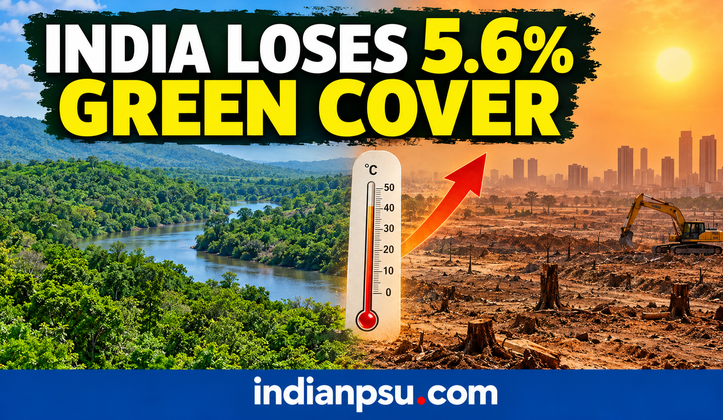
India’s green cover declined by 5.6 percentage points between 2001 and 2025, while non-green landscapes expanded significantly, contributing to rising summer temperatures across the country, according to a new study by Climate Trends.
The study, titled “Assessment of Green Cover Dynamics and Their Influence on Summer Temperature across India, Using MODIS Land Cover and ERA5 Reanalysis Data”, highlights the critical role of vegetation in regulating land-surface temperatures and reducing heat stress.
The findings show that green cover declined from approximately 36.95% of the country’s land area in 2001 to 31.35% in 2025. During the same period, the proportion of non-green landscapes increased from 63.05% to 68.65%, reflecting the expansion of sparsely vegetated and human-modified surfaces.
The study underscores the growing importance of protecting existing vegetation and restoring degraded landscapes as India confronts rising temperatures and increasing climate risks.
Green Areas Up to 2.5°C Cooler Than Non-Green Landscapes
The analysis found that non-green surfaces consistently recorded higher summer temperatures than green-covered areas throughout the study period. The average summer temperature difference between the two categories ranged from approximately 1°C to 2.5°C.
Vegetation helps moderate temperatures through evapotranspiration, shading and the retention of surface moisture. The findings indicate that green cover is not merely an ecological asset but also an important component of climate-adaptation infrastructure.
Areas experiencing green-cover loss recorded a mean summer temperature increase of 0.26°C, suggesting an association between the conversion of vegetated land into non-green surfaces and local warming.
Although both green and non-green regions experienced warming over time, areas retaining vegetation consistently maintained lower temperatures than non-green landscapes.
The researchers also found that vegetation influences the broader distribution of summer temperatures across India, helping moderate local thermal conditions even as regional climate warming continues.
Northwestern and Northern India Face Pronounced Warming
The study identified considerable regional variations in summer temperature changes.
Warming was particularly evident across northwestern and northern India, while localised cooling occurred in parts of central and southern India.
The loss of green cover was also geographically uneven. Significant changes were observed across western India, the Indo-Gangetic Plain, parts of central India and several regions of peninsular India.
In contrast, localised gains in green cover were recorded in parts of the northeastern states, the Himalayan foothills and scattered areas of southern and eastern India.
These variations demonstrate that land-cover changes and regional climatic conditions interact in complex ways. The study cautions that temperature changes cannot be attributed to land-cover transitions alone, as large-scale climate warming also plays a significant role.
Vegetation restoration can reduce local thermal stress, but it cannot fully counter the effects of broader climate change.
India Needs a Dual Strategy to Combat Heat Stress
Dr S K Dhaka, Professor of Atmospheric Physics at Delhi University, said vegetation restoration could help reduce local thermal stress but should not be treated as a substitute for wider climate action.
“The warming observed even within areas that remained continuously green shows that large-scale climatic forcing continues to influence regional temperatures,” he said.
Dr Dhaka emphasised the need for a dual strategy that combines the protection of established vegetation with scientifically targeted restoration in heat-vulnerable regions.
He also called for stronger action on water management, urban planning and greenhouse-gas emissions.
The findings reinforce the need to integrate vegetation conservation into urban development, infrastructure planning and regional climate-adaptation strategies, particularly in areas where declining green cover coincides with rising summer temperatures.
Climate Trends Calls for Protection and Restoration of Green Cover
Aarti Khosla, Founder-Director of Climate Trends, said the study quantified the relationship between vegetation loss and rising temperatures, highlighting the importance of green cover in building climate resilience.
“Where green cover has disappeared, temperatures have risen with it, and that is a cost India’s communities are already paying for,” Khosla said.
She stressed that protecting and restoring green cover must be viewed as a climate-adaptation priority rather than solely as a biodiversity conservation measure.
Khosla also pointed to the challenges facing global biodiversity conservation and ecosystem restoration efforts, arguing that the gap between international commitments and implementation makes domestic action increasingly important.
She said restoring and protecting vegetation was essential not only for biodiversity but also for keeping landscapes cooler and making communities more resilient to climate-related risks.
Extreme Weather Risks Add to Concerns Over India’s Climate Resilience
The study’s findings come amid growing concerns over India’s exposure to extreme heat, rainfall variability and climate-related economic risks.
The supplied study briefing points to projections of a strong El Niño event and the possibility of elevated temperatures in the coming seasons. Such forecasts, however, are subject to evolving meteorological assessments and should be distinguished from the study’s historical findings.
The briefing also highlights concerns over below-average monsoon performance and uneven rainfall distribution, factors that can intensify water stress and agricultural vulnerability in affected regions.
The economic consequences of rising heat are also significant. Research by the International Labour Organization and the Council on Energy, Environment and Water has highlighted the potential effects of heat stress on labour productivity and economic output.
For India, the challenge is particularly acute because high temperatures affect outdoor workers, agricultural labourers, construction activities and other heat-exposed occupations.
Protecting vegetation, improving water management and incorporating heat mitigation into urban planning could help reduce some of these risks, although broader emissions reductions and climate adaptation remain essential.
Study Recommends Preventing Further Green-Cover Loss
The researchers recommend prioritising the conservation of existing vegetation, preventing avoidable green-cover loss and promoting ecological restoration as integral elements of sustainable land management.
The findings suggest that protecting mature vegetation should receive particular attention in regions experiencing simultaneous green-cover decline and rising temperatures.
Restoration efforts should also be tailored to local ecological and climatic conditions rather than relying on uniform planting targets. The objective should be to establish and maintain vegetation that can deliver lasting ecological benefits and help moderate local heat.
The study concludes that vegetation alone cannot reverse the effects of large-scale climate change. However, conserving and restoring green landscapes remains an important natural mechanism for reducing local thermal stress and strengthening climate resilience.
As India faces mounting pressure from rising temperatures, the findings place renewed emphasis on treating green cover as an essential component of climate adaptation, alongside sustainable land-use planning, water conservation and emissions reduction.
Methodology
The study assessed the relationship between long-term land-use and land-cover dynamics and summer surface temperatures across India using MODIS land-cover products and ERA5-Land temperature data for 2001–2025.
The researchers integrated land-cover information from different periods with seasonal temperature observations for March, April and May (MAM) to quantify changes in green-cover extent and assess their relationship with spatial patterns of summer warming.
The analysis examined temperature differences between green and non-green landscapes, regional variations in warming and cooling, and the geographical distribution of green-cover gains and losses.
The findings highlight the importance of considering both land-cover changes and broader climatic influences when developing strategies to manage rising temperatures.
The writer of this article is Dr. Seema Javed, an environmentalist & a communications professional in the field of climate and energy