
MMDR Amendment Act 2026: The Jharkhand Revenue Battle Behind Hemant Soren’s Opposition
The Jharkhand government's own Mines and Geology Department describes the State as first in coal reserves, second in iron ore reserves and third in copper ore reserves
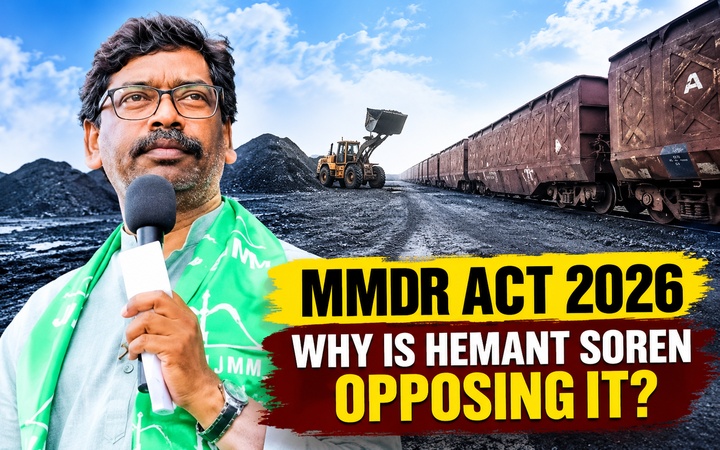
If the Centre sees the MMDR Amendment Act, 2026 as a reform aimed at bringing predictability to India’s mining sector, Jharkhand Chief Minister Hemant Soren and the Jharkhand Mukti Morcha (JMM) see it very differently.
Soren has emerged as one of the most vocal opponents of the legislation. On August 13, immediately after Parliament passed the legislation, he wrote to Prime Minister Narendra Modi seeking reconsideration of the measure. He has also sought the intervention of President Droupadi Murmu, while the JMM has decided to make opposition to the legislation a major political issue in Jharkhand.
The fundamental disagreement is over who should have the final fiscal say over mineral resources located within a State.
Jharkhand Has More at Stake Than Most States
Jharkhand is not an ordinary mineral-producing State. Its economy, public finances and political history are deeply intertwined with mining.
The State is home to enormous reserves of coal and iron ore and is also endowed with copper, bauxite, uranium, mica, graphite and several other minerals. The Jharkhand government’s own Mines and Geology Department describes the State as first in coal reserves, second in iron ore reserves and third in copper ore reserves.
The State government therefore regards mineral revenue not merely as a source of taxation but as an important component of its fiscal capacity.
And this is where Section 9D becomes politically explosive.
The Centre’s argument is that States should not be able to introduce fresh taxes, cesses or duties on mineral rights or mineral-bearing land in a manner that creates uncertainty for investors and mining companies.
Soren’s counterargument is essentially that such restrictions could substantially curtail the fiscal powers of a mineral-rich State and interfere with its constitutional and economic interests.
The ₹7,110-Crore Question
Soren’s opposition becomes clearer when viewed through the specific financial implications for Jharkhand.
According to the Chief Minister’s communication to the Centre, Jharkhand’s Mineral Bearing Land Cess was projected to generate approximately ₹7,110 crore annually. Soren has argued that mining revenues are critical to the financial stability of the State and that restricting its ability to levy charges could have a significant impact on Jharkhand’s finances.
This is therefore not merely a theoretical constitutional argument.
For a State whose economy is heavily dependent on mineral extraction, the power to raise revenue from mineral-bearing land has a direct fiscal consequence.
The Centre may argue that States will continue to receive the bulk of mining-sector revenues. Jharkhand’s response is that the issue is not only how much revenue States receive under the existing framework, but whether States retain the authority to determine and create legitimate sources of mineral-related revenue within their constitutional domain.
That distinction is at the heart of the confrontation.
Centre Says Revenue Remains With States; Soren Says Powers Matter
This creates perhaps the most interesting contradiction surrounding the legislation.
The Centre’s position is that the amendment does not take away the States’ economic benefits from mining. States will continue to receive substantial revenues through royalties, auction premiums, DMF contributions and other mechanisms.
Jharkhand, however, is looking at the question from a different angle.
Revenue sharing and revenue-raising powers are not necessarily the same thing.
A State may continue receiving its statutory share of mining revenue while simultaneously losing some flexibility to impose additional fiscal measures on mineral-bearing land.
That is precisely why Soren has framed the issue not merely as a question of money, but as a question of federalism and State rights. His objection is that the amendment could weaken the States’ constitutional authority over mineral resources located within their territories.
The Jharkhand government’s Department of Mines and Geology itself describes mineral administration as a State responsibility involving mineral leases, mineral revenue collection and the sustainable utilisation of the State’s mineral potential.
Why JMM Has Chosen a Political Fight
For the JMM, the issue has an additional political dimension.
Jharkhand was created in 2000 after a long political movement centred substantially on identity, land, forests and control over natural resources. The politics of Jharkhand has consequently always had a strong resource-sovereignty component.
The JMM’s opposition to the MMDR amendment fits naturally into that political narrative.
By opposing the legislation, Soren can position himself as defending Jharkhand’s mineral wealth and the fiscal and constitutional rights of the State against what his party portrays as excessive Central intervention.
The political stakes are therefore considerably larger than a technical amendment to a mining law.
The JMM has announced a statewide campaign against the legislation, while opposition parties in Jharkhand have rallied around concerns over State powers and mineral revenues.
But There Is Another Side to the Argument
The Centre’s supporters, particularly the BJP in Jharkhand, have rejected the Soren government’s interpretation.
BJP leaders have accused the JMM-led government of turning the issue into a political confrontation and have argued that the amendment is intended to bring greater transparency, predictability and efficiency to mineral governance rather than deprive Jharkhand of its legitimate revenues.
That counterargument deserves consideration.
India’s mineral sector has historically suffered from regulatory fragmentation. If every State can introduce new fiscal burdens on mineral rights or mineral-bearing land after investment decisions have been made, companies may factor that uncertainty into investment decisions—or avoid marginal projects altogether.
From the Centre’s perspective, therefore, a predictable national mining regime is not merely an industry demand; it is a national economic and strategic requirement.
The Real Battle: Federalism Versus Predictability?
This makes the MMDR Amendment Act, 2026 particularly significant.
The dispute is no longer simply between the government and mining companies.
It is increasingly a debate between two competing visions of mineral governance.
The Centre’s vision: mineral resources have strategic national importance and require a predictable, coordinated fiscal and regulatory regime capable of attracting investment and ensuring critical-mineral security.
Jharkhand’s vision: mineral-bearing States must retain meaningful fiscal and administrative powers over resources located within their territories, particularly when those resources are central to their economies and development.
Neither argument can be dismissed lightly.
India needs investment certainty. But India is also a federal Union in which States have legitimate constitutional and economic interests in their natural resources.
And Jharkhand presents the sharpest possible test of that balance.
The Jharkhand Test
The irony is that the very success of India’s mineral economy has made the federal question more complicated.
States such as Jharkhand bear many of the environmental, social and infrastructural consequences of mining, while the minerals extracted from their territory feed steel plants, power stations, manufacturing industries and national infrastructure across the country.
The State therefore wants both a fair economic return and adequate fiscal autonomy.
The Centre, on the other hand, wants to prevent a proliferation of State-level levies that could increase the cost of minerals and undermine investment certainty.
That is why Hemant Soren’s opposition cannot simply be characterised as resistance to mining reform.
It is better understood as a confrontation over where the line should be drawn between national mineral policy and State fiscal sovereignty.
For the Centre, Section 9D is a mechanism to create certainty.
For Jharkhand, the same provision raises the question of whether certainty for investors could come at the cost of fiscal autonomy for mineral-rich States.
That is the real fault line in the MMDR Amendment Act, 2026—and Jharkhand has chosen to stand directly on it.