
ONGC CMD Race: Can R.K. Rath’s Performance Outweigh Political Perception?
Or will the Old Political Perception Continue to Haunt R.K. Rath in the ONGC Race?
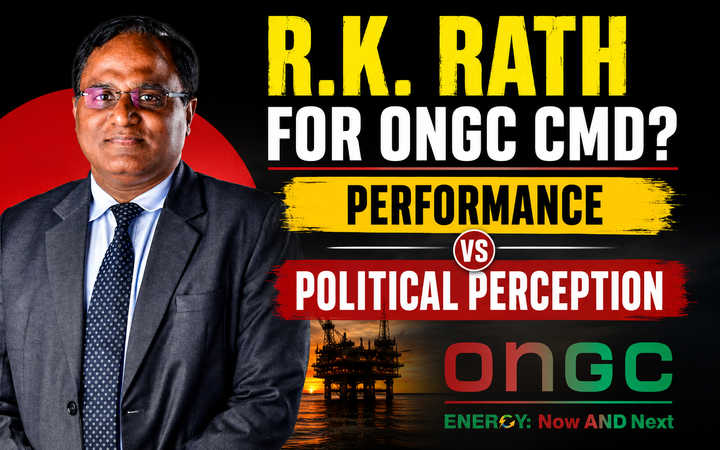
If Dr. Ranjit Kumar Rath is indeed in the race for the chairmanship of ONGC, India’s most consequential oil and gas leadership position, the debate should go beyond his credentials and professional record.
It should also examine a question that has followed his career in Delhi’s petroleum establishment: how much does political proximity matter in the making of a PSU chief — and does that equation continue to matter when the political landscape changes?
Rath’s elevation as Chairman and Managing Director of Oil India Limited came during Dharmendra Pradhan’s tenure as Union Minister for Petroleum and Natural Gas. At the time, his appointment generated discussion in political and bureaucratic circles. The fact that both Rath and Pradhan hail from Odisha became part of that conversation, with some observers viewing the Odisha connection as a possible factor in Rath’s rise.
But perception is not proof.
There is no basis to convert corridor speculation into an established fact. The more relevant point is that Pradhan was the political head of the Petroleum Ministry during an important phase of Rath’s career, and Rath subsequently rose to become one of the prominent leaders of India’s oil and gas sector.
Today, however, the equation is different.
Pradhan is no longer the Petroleum and Natural Gas Minister. The ministry has a different political leadership, the administrative ecosystem has evolved, and the power equations surrounding appointments to the commanding heights of India’s petroleum sector have inevitably changed.
And now Rath is being discussed as a potential contender for the ONGC chairmanship.
That makes the question unavoidable:
If Rath’s earlier rise was perceived in some quarters through the prism of his proximity to the Pradhan era, what should matter in the present ONGC race — his past political associations, his current institutional standing, or simply his performance?
The answer ought to be clear.
A senior PSU executive should ultimately be judged on professional competence, leadership, institutional credibility, strategic vision and measurable performance — not on assumptions about political relationships.
At the same time, it would be unrealistic to pretend that relationships between senior PSU executives and political establishments do not exist. Public-sector leadership operates within a government ecosystem. Maintaining professional working relationships with successive governments and ministers is part of the job.
The real test, therefore, is not whether a candidate has interacted with political leaders.
It is whether the candidate can demonstrate that his or her professional standing is strong enough to survive changing political equations.
That is precisely where the ONGC race becomes interesting.
ONGC is not merely another PSU. It sits at the heart of India’s exploration and production strategy and remains central to the country’s long-term energy-security ambitions. Its chairman will be expected to navigate difficult questions involving domestic exploration, production growth, technology, capital allocation, overseas opportunities, energy transition and the continuing strategic importance of hydrocarbons.
The selection, therefore, deserves to be based on the strongest possible assessment of leadership capability.
For Rath, this could be an important moment.
His record at Oil India will inevitably come under scrutiny. So will his ability to lead an organisation substantially larger and more strategically significant than the one he currently heads. His experience, administrative record, strategic decisions and ability to deliver will all matter.
But so too will the question of perception.
- Can Rath’s candidature now be evaluated independently of the political circumstances surrounding his earlier rise?
- Or will the old narrative about the Pradhan era continue to follow him into the ONGC race?
And perhaps the more important question is this:
If political equations have changed, has Rath’s professional standing evolved sufficiently to make those equations irrelevant?
That is not an allegation against Rath. It is a legitimate question about how India selects the heads of its largest public-sector enterprises.
If the selection process is genuinely merit-driven, the answer should ultimately emerge from the record.
The ONGC chairmanship should go to the candidate who demonstrates the strongest combination of leadership, experience, institutional credibility and strategic capability — regardless of who was in power when that candidate first rose through the ranks.
For Rath, therefore, the ONGC contest could represent something larger than the next step in a successful career.
It could be a test of whether a PSU chief can move beyond the perceptions surrounding his political beginnings and establish an independent professional identity powerful enough to withstand changing governments and changing power centres.
And for the system, the question is even bigger.
Is India finally ready to select its most important PSU leaders primarily on performance and institutional credibility — rather than perceptions of proximity to political power?
The answer will say as much about India’s PSU appointment system as it will about R.K. Rath.