

SAIL Manpower Axe: Why Cut Jobs in a Profitable Maharatna PSU?
SAIL had already retired 11 executives in 2025 following its internal review process. Some affected officers reportedly challenged the action before courts

Steel Authority of India Limited (SAIL) is a profitable Maharatna public sector undertaking, not a company fighting for survival.
Yet, the steel major has begun another exercise to identify officers for compulsory retirement, while a broader manpower-rationalisation exercise is also being pursued.
That raises a fundamental question:
Why is a profitable Maharatna PSU being pushed towards manpower reduction—and is the objective to make SAIL more efficient, or simply smaller?
The question becomes more significant amid information that a senior official in the Ministry of Steel is strongly advocating manpower reduction in SAIL. Sources indicate that the thinking is also being viewed in the context of manpower rationalisation undertaken at Rashtriya Ispat Nigam Limited (RINL).
If the same policy prescription is now being considered for SAIL, the Ministry of Steel needs to answer a straightforward question:
What lessons has it drawn from the RINL experience?
SAIL is not RINL
SAIL and RINL have very different financial and operational circumstances.
SAIL remains a major profitable steel producer with integrated plants, captive mines, technical institutions and a large pool of experienced personnel.
RINL, meanwhile, has faced prolonged financial and operational difficulties.
Therefore, applying a similar manpower-reduction philosophy to the two companies cannot be justified merely by saying that a smaller workforce means a more efficient organisation.
Steel plants are not spreadsheets.
Productivity depends not only on the number of employees but also on technology, capacity utilisation, maintenance, skill levels, safety, management systems and accumulated institutional knowledge.
The loss of experienced technical and managerial personnel can have consequences that may not immediately appear in a balance sheet.
What exactly is FR 56(j)?
The term FR 56(j) needs to be understood correctly.
It is a provision under the Government of India’s Fundamental Rules relating to retirement in the public interest. It is not the same thing as dismissal for misconduct.
Broadly, the provision allows the competent authority, subject to applicable rules and a prescribed review, to retire an eligible employee before normal superannuation if continued retention is considered not to be in the public interest.
The review can take into account factors such as integrity, efficiency, conduct and the employee’s service record.
Therefore, it would be wrong to suggest that an officer is automatically “sacked” simply because he has crossed a particular age or completed a specified number of years of service.
There is another important qualification in the case of SAIL.
SAIL is a PSU, not a Central Government department. Its executives are governed by the service rules applicable to the company. Therefore, the precise legal provision, criteria and procedure being used in individual cases must be established rather than assuming that FR 56(j) applies to every SAIL employee in exactly the same manner as it applies to a government servant.
That makes transparency critical.
If the provision is being used to identify genuinely inefficient or unsuitable personnel, management should be able to demonstrate the basis of its decisions.
But if it is effectively being used to achieve a predetermined reduction in manpower, another question arises:
Is a public-interest retirement provision being turned into a manpower-cutting instrument?
Eleven executives were retired in 2025
The issue is not entirely new.
SAIL retired 11 executives in 2025 following its internal review process. Some of the affected officers reportedly approached courts challenging the decisions.
The renewed exercise in 2026 therefore deserves even greater scrutiny.
SAIL has also been working on a new performance evaluation approach during 2026-27, with manpower rationalisation and action against poor performers forming part of the broader discussion.
There is nothing wrong with a PSU demanding accountability.
But accountability should be based on transparent, objective and measurable criteria.
The question should not simply be how many employees can be removed.
It should be:
What manpower does SAIL actually require to operate its plants and mines safely, efficiently and competitively?
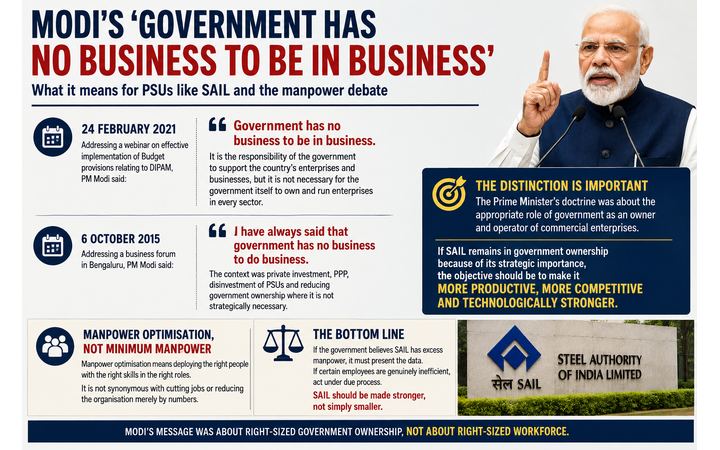
If SAIL is strategic, make it stronger—not merely smaller
If the government believes SAIL should remain a public-sector steel major because steel is strategically important to India’s economic and national objectives, then the priority should be to build a world-class SAIL.
That means:
- modern technology;
- higher productivity;
- better capacity utilisation;
- stronger safety standards;
- improved skills;
- accountability for poor performance;
- redeployment and reskilling where required; and
- optimum deployment of manpower.
The last point is crucial.
Optimum manpower does not necessarily mean minimum manpower.
A steel plant may have surplus employees in one function and a shortage of specialised skills in another. In such a situation, redeployment, reskilling and restructuring may produce better results than simply retiring experienced employees.
The RINL question cannot be avoided
This is where the Ministry of Steel needs to explain its thinking.
If manpower reduction is being presented as an important element of improving PSU performance, what measurable results did the approach produce at RINL?
Did productivity improve?
Did financial performance improve?
Did operational efficiency improve?
Did the organisation become more competitive?
And if the results were not sufficient, why should the same philosophy now be applied to SAIL?
These are legitimate policy questions.
They are not an argument against reform.
They are an argument for evidence-based reform.
Avinash Jha returns to Bokaro
Amid these developments, Avinash Jha, General Manager (Personnel) at SAIL’s Centre for Engineering and Technology, Ranchi, has been transferred to Bokaro Steel Plant as General Manager (Personnel).
Jha had earlier served at BSL as Deputy General Manager (Personnel).
His appointment comes at an important time for the plant’s personnel administration, with changes in the senior HR structure and another senior personnel executive due to retire later this year.
His experience could become particularly relevant if SAIL moves ahead with a wider performance and manpower review.
The real question: Stronger SAIL or smaller SAIL?
There is no argument against removing genuinely inefficient personnel.
There is no argument against modernising a legacy workforce.
There is no argument against deploying manpower more efficiently.
But there is a strong argument for asking whether headcount reduction itself has become the objective.
SAIL is a profitable Maharatna PSU. It has strategic assets, skilled personnel and an important role in India’s steel ambitions.
If it has excess manpower, management should demonstrate it through plant-wise, function-wise and skill-wise data.
If certain officers are genuinely unsuitable for continued service, the company should act under applicable rules and due process.
But if the policy is primarily about reducing numbers, the Ministry of Steel needs to explain why.
The bottom line
Prime Minister Modi’s famous formulation—“Government has no business to be in business”—was fundamentally about the government’s role as an owner of commercial enterprises.
If the government decides that SAIL remains strategically important enough to stay in the public sector, then the objective should be to make SAIL stronger, more competitive and more productive.
Not simply smaller.
The Ministry of Steel therefore owes SAIL’s employees, stakeholders and the public some straightforward answers:
How much surplus manpower does SAIL actually have?
What methodology has been used to determine it?
What savings are expected?
What lessons have been learnt from RINL?
And ultimately: Is SAIL being made leaner because it genuinely has excess manpower—or is manpower reduction being treated as a substitute for deeper structural reform?
For a Maharatna PSU, smaller is not automatically stronger.
And if SAIL is profitable, the burden of proof for a large-scale manpower axe should be even higher.
We Report – You Decide…