
Visakha Steel Employees Union Flags VRS Payment Delay, Seeks Immediate Release of Dues
Union alleges breach of VRS commitments, questions staggered payments and seeks government intervention for affected employees
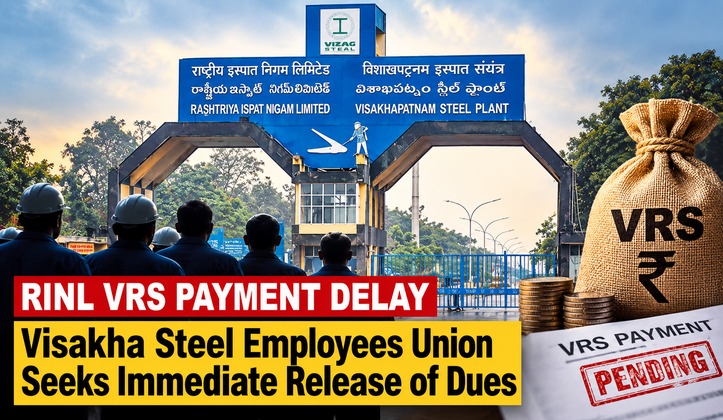
Padi Thrinadha Rao, General Secretary of the Visakha Steel Employees Union at Visakhapatnam Steel Plant, has written to the Cabinet Secretary, Principal Secretary to the Prime Minister, Secretary, Ministry of Steel, Secretary, Department of Public Enterprises (DPE), and the Prime Minister’s Office, seeking immediate payment of pending VRS compensation and other dues to employees who opted for voluntary retirement from RINL.
In his representation, Rao alleged that RINL has violated the terms of its VRS scheme by withholding a substantial portion of the compensation payable to employees who opted for the scheme as part of the ₹11,440-crore revival package for the company.
Union alleges violation of VRS payment commitments
According to the representation, around 1,600 RINL employees opted for VRS, accepting compensation reportedly 35% to 45% lower than their actual salaries in the process of relinquishing their permanent employment.
The union has alleged that, under the RINL VRS circular and applicable DPE guidelines, statutory dues and VRS compensation were required to be settled at the time of separation. However, it claims that the entire package was not paid to employees under VRS-2 in October 2025 and VRS-3 in April 2026.
Rao termed the withholding of the balance payment a serious violation of the commitments made to employees at the time they opted for VRS.
Six-instalment payment plan questioned
The union has particularly objected to a second RINL circular issued on September 28, 2026, which, according to the representation, provides for payment of the remaining VRS-2 compensation in six instalments.
The circular also reportedly provides for payment of the remaining 75% of the VRS-3 compensation in six instalments beginning October 2026.
The union has described the move as a further breach of the original VRS terms, arguing that employees had taken an irreversible decision to leave service based on the conditions communicated by RINL.
Different payment patterns alleged
Rao has also questioned what he described as different payment approaches adopted for successive batches of VRS employees.
According to the union:
- VRS-1: The total package was paid within one month.
- VRS-2: Only 50% was paid after two months, with the balance still pending even after a year.
- VRS-3: Only 25% of the package was paid.
The union has questioned why employees covered under the same VRS framework have allegedly been subjected to different payment schedules.
Union highlights ₹60 crore monthly savings
The representation also points to the financial savings generated by the VRS exercise.
According to the union’s estimate, RINL is saving around ₹60 crore every month following the separation of approximately 1,600 employees. It claims that the savings over the past year have already reached around ₹500 crore.
Against this, the union states that the pending VRS-2 compensation is approximately ₹58 crore, besides around ₹17 crore towards earned leave (EL) encashment.
Rao has therefore questioned why the outstanding VRS liabilities cannot be cleared through a one-time payment.
TDS deduction becomes another point of contention
The union has also raised questions over the deduction of income tax at source from the VRS package.
According to the representation, RINL deducted TDS on the full VRS package in October 2025, although only a portion of the compensation was actually paid to employees in certain categories.
The union claims that approximately ₹75 crore remains pending even after one year.
Employees facing financial and personal distress
The representation argues that employees opted for VRS after making financial plans around receiving the promised lump-sum compensation.
Rao stated that many VRS optees had intended to deploy the money towards children’s education, housing loan EMIs, medical expenses of parents, marriages and other family commitments.
The delay in receiving the balance amount has, according to the union, caused financial hardship and severe mental stress among the affected employees.
Union raises legal and policy questions
The Visakha Steel Employees Union has invoked the principles of legitimate expectation and promissory estoppel, arguing that employees took an irreversible decision to leave RINL based on the terms contained in the VRS circular.
The representation further points out that VRS optees face restrictions on taking up employment in government companies, making the decision to opt for VRS particularly consequential.
The union has questioned whether a public sector enterprise can subsequently alter the financial terms of a VRS scheme after employees have surrendered their permanent employment.
Seeks immediate one-time settlement
Rao has urged the Union Government to intervene and direct the Ministry of Steel to instruct RINL to immediately release all outstanding legally payable dues to VRS optees.
The union has specifically sought payment of the entire pending VRS compensation and earned leave encashment in one lump sum, along with applicable interest, rather than through instalments.
The representation has also sought intervention from the highest levels of the government, questioning whether a PSU can alter commitments made under a VRS scheme at its convenience and calling for accountability for the alleged violation of prescribed norms.
The Visakha Steel Employees Union has appealed for immediate government intervention to ensure that the affected VRS employees receive their pending dues without further delay.