
B. Sairam’s Coal India Reset: From Production Giant to Technology-Driven Energy Powerhouse
For decades, Coal India Limited was defined by one overriding number: coal production
With a ₹1 lakh crore investment roadmap, smart mining, faster coal evacuation, gasification and a push into critical minerals, B. Sairam is seeking to change not just how Coal India mines coal, but what the company ultimately becomes.
For decades, Coal India Limited was defined by one overriding number: coal production.
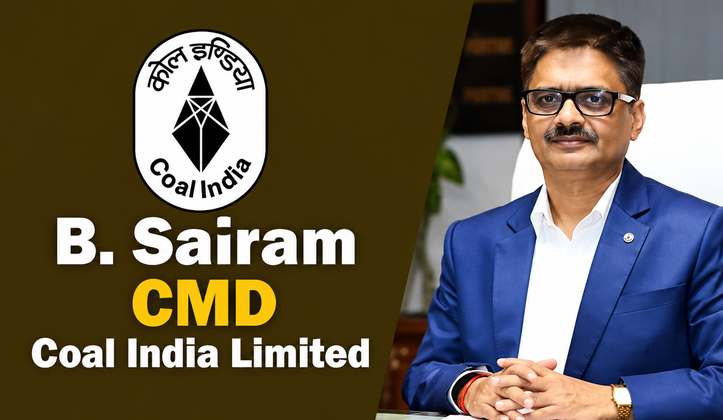
Under Chairman-cum-Managing Director B. Sairam, that equation is beginning to change.
Since taking charge in December 2025, Sairam has pushed a broader agenda built around technology, logistics, productivity, diversification and capital deployment. He has described 2026 as a “Year of Reform and Transformation”, with a reform programme covering exploration, mining, evacuation, marketing, HR and technology.
The central message is clear: Coal India cannot remain merely a company that digs coal out of the ground.
From production to delivery
The first major shift is from a production-centric model to a supply-and-demand-driven model.
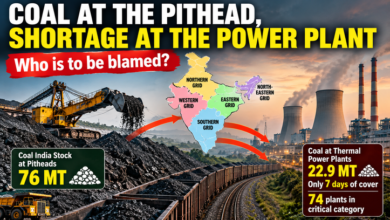
Coal India has historically maintained substantial stocks at mineheads. Sairam’s strategy is to reduce inventories while ensuring that coal moves faster from mines to consumers.
That makes First Mile Connectivity (FMC) critical.
CIL is investing heavily in mechanised systems involving crushers, conveyors, silos and rapid railway loading. The objective is to reduce dependence on road transportation, cut handling requirements and move coal from pithead to customer more efficiently.
The philosophy is simple:
Produce what the market needs, evacuate it faster and get it to the customer efficiently.
This is a significant change for a company whose performance has traditionally been judged primarily by how much coal it produces.
Technology moves to the centre
The second pillar is technology.
CIL is increasingly deploying artificial intelligence, machine learning, drones, advanced geological exploration, data analytics, automated systems and predictive maintenance across its operations.
The objective is not merely to digitise existing processes. Technology is being used to improve mine planning, identify geological resources, monitor equipment, enhance productivity and reduce workers’ exposure to hazardous operations.
Advanced exploration, including 2D and 3D seismic surveys, is also becoming increasingly important.
For a company operating hundreds of mines across multiple coalfields, the potential impact is enormous.
The traditional mine is gradually becoming a data-driven industrial operation.
₹1 lakh crore investment push
The scale of the transformation is reflected in CIL’s proposed capital expenditure roadmap of around ₹1 lakh crore through FY2030-31.
The investment is not confined to conventional mining.
It encompasses mining infrastructure, First Mile Connectivity, technology, coal gasification, thermal power, renewable energy and critical minerals.
That makes the programme more than a mine-expansion exercise. It is an attempt to create multiple growth engines around Coal India’s existing coal business.
Coal gasification: extracting more value from coal
One of the most ambitious components is coal gasification.
CIL is pursuing projects involving investments of around ₹50,000 crore, with the objective of converting coal into higher-value products rather than limiting the business to the sale of raw coal.
Gasification can potentially create opportunities in chemicals, fertiliser-related products and other downstream industries.
A major project being pursued by CIL is the Lakhanpur coal-to-ammonium-nitrate project in Odisha.
The strategic idea is important: instead of selling only the resource, create additional value from the resource.
Beyond coal
Perhaps the most significant part of Sairam’s strategy is diversification.
CIL is looking at renewable energy, thermal power, battery storage, coal-to-chemicals and critical minerals.
Critical minerals are particularly important because India’s future manufacturing and clean-energy ambitions require reliable supplies of minerals such as lithium, graphite and vanadium.
CIL has already begun participating in the critical-mineral opportunity and is examining both domestic and overseas possibilities.
This represents a fundamental expansion of the company’s traditional identity.
Coal remains the core business—but the ambition is to build businesses around the broader natural-resources and energy ecosystem.
The real test is execution
Sairam’s strategy is ambitious, but the transformation is still underway.
A ₹1 lakh crore investment roadmap, gasification projects, critical-mineral ventures and large technology programmes will take years to fully execute.
The real test will therefore be whether the strategy produces measurable improvements in productivity, costs, safety, evacuation, profitability and shareholder value.
But the direction of travel is already evident.
The old Coal India model was essentially:
Mine → Produce → Dispatch.
The emerging model is:
Explore intelligently → Mine efficiently → Automate → Evacuate faster → Supply according to demand → Create downstream value → Diversify into new resources and energy businesses.
That is the real significance of the B. Sairam reset.
He is not simply trying to make Coal India produce more coal.
He is attempting to make the world’s largest coal producer smarter, more technology-driven and less dependent on coal alone for its future growth.
And if the strategy is executed at the scale envisaged, the Coal India of the next decade could look very different from the Coal India of the past.